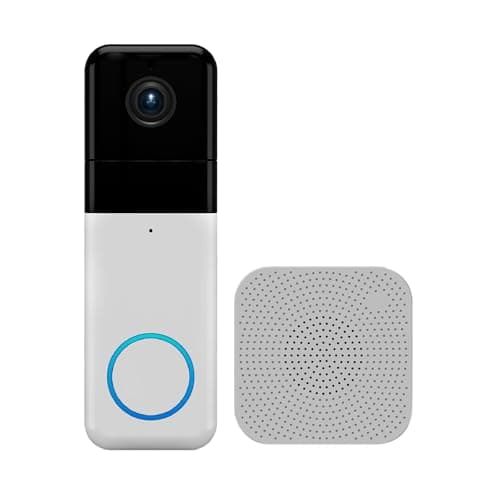
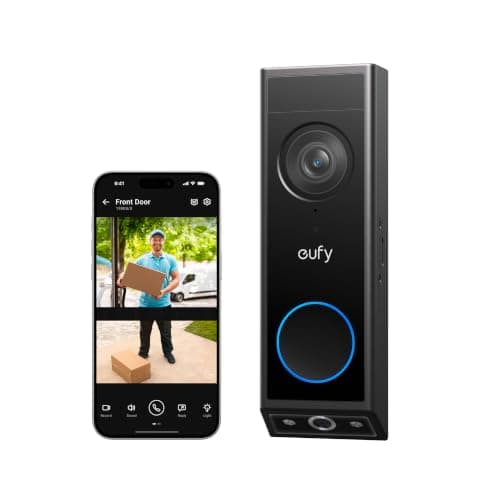
This is the money page, so we will be blunt: if you never want a monthly bill for your doorbell, two products do the whole job without one. Both keep your recorded clips on the device itself — the eufy E340 on 8GB of built-in storage, the Wyze Pro on a microSD card you add — so you can go back and watch what happened at the door without ever paying a cloud fee.
We lead with the eufy Video Doorbell E340 because it does not feel like a compromise. It has a genuinely useful second camera pointed down at the step, so packages don't vanish below the frame the way they do on a single wide lens; it shoots a tall 2K Head-to-Toe view; and it installs on battery or existing doorbell wiring. The 8GB it ships with quietly records your events with no plan attached. That combination is why it also tops our main doorbell roundup's no-fee slot.
The Wyze Video Doorbell Pro is the pick when price is the deciding factor. It records 1440 HD in a square 1:1 shape — tall enough to show a visitor and the doorstep together — comes with a plug-in chime, and stores clips on a microSD card for nothing. The catch is honest: you buy and insert the card, the app is functional rather than plush, and the smartest AI alerts sit behind Wyze's optional Cam Plus plan. If you are comfortable with a little setup, the savings are real.
Why does "no subscription" matter so much on a doorbell? Because the fee is the part the box never advertises. A Ring or Nest doorbell gives you a free live view and alerts, but the recorded clip — the reason most people buy a doorbell — needs a plan, and that plan runs for as long as you own the device. Over three years, that recurring cost can rival the price of the hardware. We put the arithmetic below so you can see it, not just take our word.
Two honest limits apply to both picks. First, local storage is finite: you occasionally clear space or drop in a bigger card, which is the trade for never paying a fee. Second, neither doorbell supports Matter or Apple HomeKit — Matter doorbell support has barely started — so you live in the eufy or Wyze app, with Alexa and Google support for voice and viewing. If you would rather understand exactly how local recording works before you buy, the storage guide is the companion read.
What "no subscription" really gets you
A fee-free doorbell trades the cloud's convenience for permanent ownership of your footage. There is no monthly charge, nothing to cancel, and your clips never leave the device unless you export them. The compromise is that history is bounded by the storage you have on hand: 8GB on the eufy, or whatever microSD card you fit in the Wyze. For most front doors, that is plenty of runway before old clips roll off.
Dual camera or single lens?
The eufy's second, downward-facing camera is the feature to understand. A normal doorbell aimed at face height often crops a parcel out of the bottom of the frame; the eufy's package camera looks straight down at the step so you can see a delivery sitting there. If package theft is your reason for buying, that is a meaningful edge over a single-lens doorbell like the Wyze.
eufy E340 vs Wyze Pro: which no-fee doorbell?
Both skip the fee, so the choice between them comes down to what you want at the door. The eufy E340 is the more capable doorbell: its dual cameras and second package view mean you see deliveries on the step, its built-in 8GB needs no card, and its 2K image is a touch sharper. Pick it if porch packages are your reason for buying and you would rather not fuss with storage at all.
The Wyze Pro is the one to choose when price leads. It costs less, includes a chime in the box, and its square 1:1 image still shows a caller and the doorstep together. The trade is that you supply the microSD card and the smartest AI alerts want the optional Cam Plus plan. For a straightforward front door where you mainly want to see and record who rings, it is plenty — and it is the cheaper way in.
Installation: battery or wired
Neither doorbell ties you to an electrician. Both run wireless on a rechargeable battery, which is the simplest install for a door with no existing wiring — you charge it every few months depending on how busy the door is. If you already have doorbell wiring, both can be hardwired so they stay topped up and you never think about the battery. The storage stays local and fee-free either way, so wiring is purely about convenience, not features.
How they compare to the subscription doorbells
If you are weighing these against Ring or Nest, the difference is not really picture quality — it is the bill. Ring and Nest lead on ecosystem polish and, in Nest's case, free on-device AI, but both charge to keep your history. Our full roundup ranks all four together, and Ring vs Nest settles the subscription-doorbell decision if that is the route you take instead.