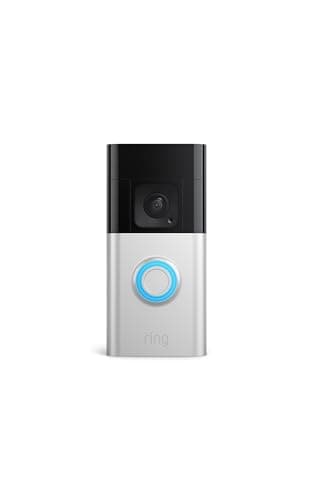
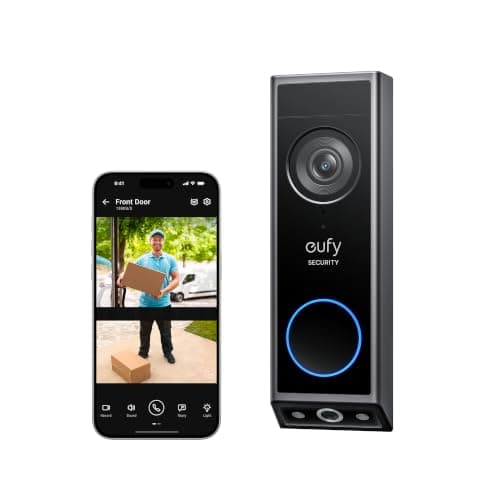
These two doorbells look similar on a shelf and cover the same core job — see who is at the door, talk to them, catch the parcel — but they answer one question in opposite ways: who owns your footage, and do you pay monthly to keep it? The eufy Video Doorbell E340 saves every clip to storage built into the unit and never charges a fee. The Ring Battery Doorbell Plus is cloud-only and locks recorded clips behind a subscription. That single split decides almost everyone, so let's work through it honestly. Both are sold on Amazon, so buying either is a tap away — the question is which one belongs at your door.
The one difference that decides it: storage and the fee
Start where your money lives for years, not at the checkout price. The eufy E340 records to 8GB of built-in local storage. When it catches motion or someone rings, the clip is saved on the doorbell itself, and you can open and replay it with no plan and no monthly bill. That is the whole pitch, and it is a strong one: the footage you actually bought a doorbell for is free to keep.
The Ring works the other way. Live view, motion alerts and two-way talk are free, but the moment you want to save and replay a recorded clip, you need a Ring Home plan. Without one, you get the alert and a live look, and if you were not watching at that second, the moment is gone with nothing stored. Ring is cloud-only by design — there is no microSD slot and no local option — so the plan is not an upsell you can route around. It is part of the product. If saved history matters to you, budget the fee from day one, exactly as we say across the best video doorbells roundup, where these two sit against the full field.
The eufy is not free of trade-offs, to be fair. 8GB is finite: on a busy street with constant motion, older clips roll off to make room unless you manage the space or clear it now and then. That is the honest counterweight to "no fee." Ring's cloud, by contrast, is something you never have to think about — it just keeps rolling as long as you pay. So the real trade is a small amount of housekeeping on the eufy versus a permanent line item on the Ring.
Cameras and view: the eufy sees the doorstep, twice
Both doorbells use a tall head-to-toe shape, which is the right call at a front door — it shows a visitor from face to feet and catches a package on the step, where a wide, short image would crop it out. The Ring delivers this as its Head-to-Toe HD+ view; the eufy delivers a 2K FHD head-to-toe view.
Where the eufy pulls ahead is its second camera. On top of the main door-facing lens, it adds a downward-facing camera aimed at the step, plus AI package detection. That means when a courier sets a box down low and steps back, you get a clear look straight down at the parcel rather than a guess from an angle. For anyone who orders a lot online, that second view is a genuinely useful piece of hardware, not a spec-sheet flourish. The Ring keeps things simpler with a single, tidy Head-to-Toe stream — clean and effective, but it is one camera watching one frame.
Ecosystem: this is where the Ring earns its place
If storage is the eufy's home turf, the ecosystem is the Ring's. The Ring Battery Doorbell Plus slots into an existing Ring and Alexa setup so cleanly that it barely feels like a separate device: one app covers the doorbell, your Ring cameras and a Ring alarm, and you can pull the feed onto an Echo Show by voice. In an Alexa household already running Ring gear, that single-app tidiness is worth real money and is the reason to choose it.
The eufy works with both Alexa and Google, but it lives primarily in the eufy app rather than blending seamlessly into either assistant's world, and there is no HomeKit Secure Video. One thing is true for both: neither supports Matter or HomeKit, so neither shows up in Apple Home. If you are an Apple household hoping to see the doorbell in the Home app, neither of these can do that today.
The three-year cost, side by side
Purchase price is only half the story; the plan is the other half. The eufy costs a little less to buy and then costs nothing to run, because saved clips live on its built-in storage. The Ring costs a bit more up front and then adds the Ring Home fee for as long as you want to keep your clips. Over three years that gap is not a rounding error — it is the difference between a one-time purchase and an ongoing bill. The table lays out both so you can see the real number rather than the sticker.
Who should buy which
Buy the eufy E340 if you never want a monthly fee, you order enough parcels to value a camera pointed at the step, and you are happy to occasionally manage local storage. It is the buyer-first pick and our top choice here for a simple reason: when a no-fee doorbell does the core job as well as a subscription one — and adds a package camera on top — it is the better buy, even though the subscription products tend to pay us more. It is also why the eufy leads our no-subscription doorbell roundup. The full walkthrough lives in the eufy Video Doorbell E340 review.
Buy the Ring Battery Doorbell Plus if you already run Alexa and Ring and value one tidy app over avoiding a fee — and you are comfortable treating the plan as part of the price. For that specific household, the convenience is worth it and the Ring is the smoother daily experience. If that is you, the Ring Battery Doorbell Plus review covers it in depth. For anyone starting fresh with no ecosystem loyalty and no appetite for a monthly bill, the eufy is the easier call.