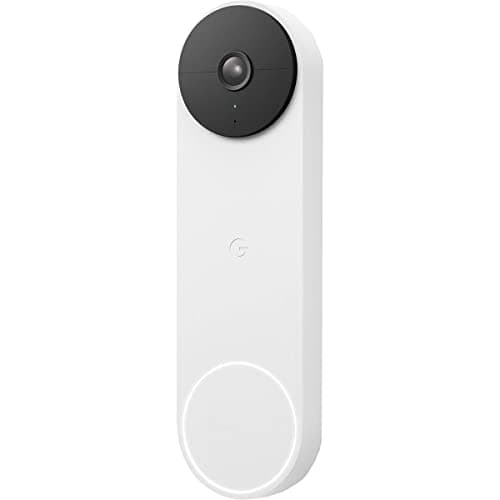
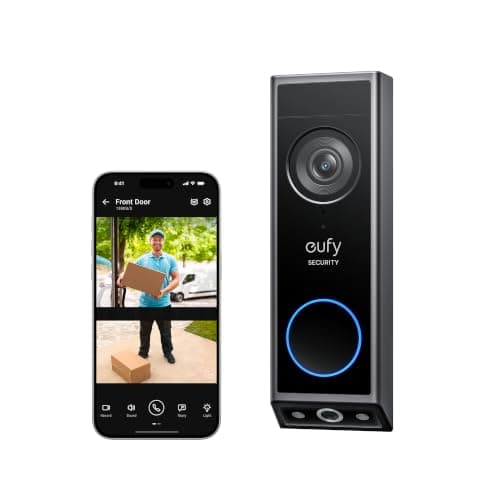
The Nest Doorbell (battery) and the eufy Video Doorbell E340 look like close cousins on paper. Both run on a rechargeable battery, both show a tall head-to-toe view of whoever is at the door, both do smart AI, and both can be hardwired if you happen to have the terminals. But the choice between them is not really about the picture - it is about two things that will shape how you live with the doorbell for years: how you feel about a monthly fee, and which ecosystem your home runs on. Get those two answers straight and this comparison settles itself.
The one decision that matters: fee model
Start with the money, because it is the fault line. The eufy E340 records to 8GB of storage built into the doorbell, and that footage costs nothing to keep or replay. There is no plan, nothing to cancel, and nothing that stops working if you never open your wallet again after buying it - your full history is free for as long as you own it. The Nest Doorbell takes the cloud approach: it gives you only about three hours of free event history, and to keep a real record beyond that you subscribe to Google Home Premium. That is a recurring cost for as long as you want your clips saved.
Neither approach is wrong, but they suit different people. The eufy's local storage means you own your footage outright and never see a bill; the trade is that 8GB is finite, so on a busy door older clips eventually roll off unless you manage them. The Nest's cloud means you never think about capacity and your history just accrues - as long as you keep paying. If your instinct is "I do not want another subscription," the eufy is already your answer, and it is why it wins the top spot here and leads our no-subscription doorbells list. If you want the exact fees the Nest route adds up to, our video doorbell subscription costs breakdown lays them out.
The second decision: which ecosystem you live in
The other half of this is ecosystem, and here the Nest has a real edge if you are the right household. The Nest Doorbell is a Google product, and it shows: a ring lands natively on your Nest Hub and Google speakers, the app is the Google Home app you already use, and the whole thing feels like one system rather than a bolt-on. For a home already invested in Google, that seamlessness is worth a lot, and it is the strongest reason to accept the plan.
The eufy is more ecosystem-neutral. It works with both Alexa and Google for voice and viewing, but it does not integrate as deeply into Google Home as a native Nest - you live primarily in the eufy app, and Google is a supported add-on rather than the home base. Neither doorbell supports Matter or Apple HomeKit, so an Apple household is not the target for either. The short version: if your home is built around Google, the Nest slots in more cleanly; if you are ecosystem-agnostic or you refuse a fee, the eufy is the more flexible choice.
Smart alerts: both are strong, in different ways
Both doorbells give you smart detection, and both do it well - this is not a case where one has AI and the other does not. The Nest runs on-device AI that sorts events into a person, a package, an animal or a vehicle, and that classification is free even on the base tier, so your alerts are meaningful out of the box. It is one of the genuinely nice things about the Nest: the smart part does not hide behind the plan; only the longer history does.
The eufy answers with AI motion and package detection of its own, and then adds the hardware trick the Nest cannot match: a second camera. The E340 carries a downward-facing lens pointed straight at the step, so a delivery that a single face-height camera would crop out of the bottom of the frame stays fully in view. If porch packages are the reason you are buying a doorbell at all, that second camera is a concrete advantage - you see the parcel on the step, not just the person who dropped it. So both are smart; the Nest is smarter about sorting what it sees for free, and the eufy is better at physically seeing the doorstep.
Video, install and daily life
On the core experience the two are closely matched. The eufy shoots a tall 2K Head-to-Toe view; the Nest shoots a tall 3:4 view. Both frame a visitor face to feet, both have night vision and two-way talk, and both are sharp enough to identify who rang. Both install the same easy way, too: mount the bracket, clip on the battery-powered doorbell, and you are done - no electrician required, and either can be hardwired to existing terminals to keep the battery topped up if you have them.
So day to day, the doorbell you notice is the one whose fee and ecosystem match your life. In a Google home that does not mind a plan, the Nest disappears into a system you already trust and quietly sorts your alerts. In a fee-averse or mixed home, the eufy keeps its footage local, watches the step for parcels, and never sends you a bill. If you are still weighing Google against the other big platform entirely, our Ring vs Nest doorbell comparison covers the Alexa-versus-Google question head-on.
Thinking past the first year
A doorbell is a multi-year purchase, so it is worth playing the two storage models forward rather than judging them on the day you unbox. With the eufy, the cost story ends at the cash register: the footage lives on the doorbell, the history is yours, and there is nothing to renew, nothing to lapse, and nothing that goes dark if you ever forget a payment. The only ongoing chore is capacity - every so often on a busy door you clear space or decide which older clips you care about keeping, because 8GB does not stretch forever. That is a small, occasional task in exchange for never seeing a line item on a statement.
With the Nest, the shape is reversed. You never manage storage - the cloud simply holds your history for as long as the plan is active - but the plan is the thing you now own alongside the hardware. Stop paying and the record beyond the short free window stops accruing; keep paying and, over the years, the recurring cost quietly becomes the larger part of what the doorbell actually costs you. Neither model is a trap - plenty of Google homes happily pay for the convenience, and plenty of fee-averse homes happily tidy a card - but they are genuinely different relationships with the same little camera. Decide which relationship you want before the box arrives, because it is the part of this choice you feel every month rather than just once. If you would rather sidestep a recurring fee entirely, the whole of our no-subscription doorbells list is built around that preference.
Who should buy which
Buy the eufy Video Doorbell E340 if you never want a bill. Its built-in 8GB keeps your history for free, its second camera watches the doorstep for packages, and it works with both Alexa and Google without locking you in. It is our top pick here because a doorbell you own outright, with no recurring cost, is the right default for most buyers - and you give up very little to get it. For the deeper look, our eufy E340 review covers it in full.
Buy the Nest Doorbell (battery) if your home runs on Google and you do not mind the plan. You get free on-device AI that sorts your alerts, a tall 3:4 view, and integration so clean the doorbell feels like part of the house rather than an add-on. Go in knowing the trade: the free history is only about three hours, so keeping a real record means paying for Google Home Premium. Our Nest Doorbell review digs into exactly what the plan does and does not include.
The usual honest caveat applies, the same one on every page here: we did not install and stress-test these two doorbells in a lab. We read each doorbell's own Amazon listing and manufacturer documentation for its specs, storage model and the ecosystems it names, and compared them straight. Where a claim would have to come from hands-on testing, we say so rather than inventing it.