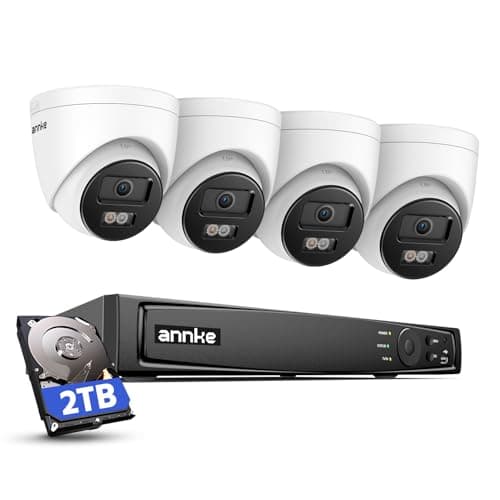
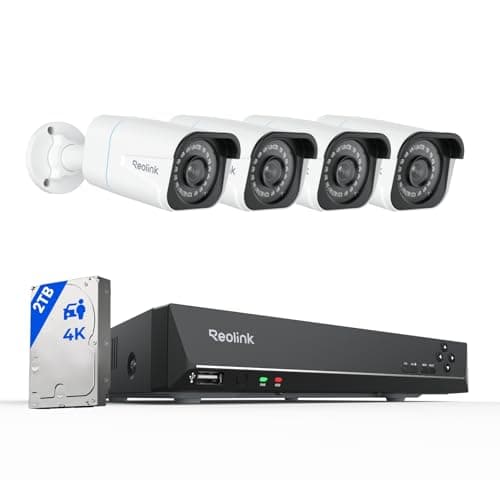
These two get cross-shopped constantly, and for good reason: on the spec sheet they are almost twins. Both the Reolink RLK8-800B4 and the ANNKE 8CH 4K PoE system are four-camera 4K kits built around an eight-channel PoE NVR with a 2TB drive in the box, both record all their cameras 24/7 to that drive, and both do it with no subscription, ever. So "which is better" is not a question about resolution or storage - those match. It is a question about camera form factor, software, openness, and which brand you would rather live with. Answer those and the winner picks itself.
The verdict up front
For most buyers, the Reolink RLK8-800B4 is the one to buy. It sits on exactly the same foundation as the ANNKE - 4K cameras, eight channels, a 2TB drive, continuous local recording, zero fees - but it pairs that foundation with a more refined, consumer-friendly app and a large, well-supported user community. That combination of polish and brand support makes it the safer mainstream pick, and it is why it earns its own full review and a spot in our best wired systems roundup.
The ANNKE wins in two situations, and it wins them cleanly. If your priority is the lowest price for the same core spec, the ANNKE is typically the value play. And if you care about openness - not being married to one company's app forever - the ANNKE is marketed as ONVIF-friendly, which means its cameras can work with third-party NVR software rather than staying locked to ANNKE's recorder. For the budget-minded buyer or the tinkerer, that is not a compromise; it is the better fit. Its full story is in our ANNKE 8CH 4K PoE review.
What they share (and why it matters)
Before the differences, be clear on how much is genuinely identical, because it removes a lot of the noise from this decision. Both kits are PoE systems: each camera runs to the recorder on a single Cat-5e cable that carries power and video together, so neither has batteries to recharge or a Wi-Fi signal to drop. Both capture 4K/8MP footage. Both ship an eight-channel NVR with a 2TB drive already installed. Both record continuously, 24/7, to that local drive. And neither charges a subscription - the footage lives in your house and stays yours on both. If you are weighing this whole wired-and-local approach against cloud cameras, our local vs cloud storage guide makes the broader case that both of these kits embody.
Both also share the same honest cost: install labor. A PoE kit is not a five-minute stick-up-and-pair job; it is an afternoon of running Ethernet to each camera position, drilling, routing and mounting - closer to installing fixtures. That is true of the Reolink and the ANNKE equally, so it is not a tiebreaker. It is simply the price of the reliability that wired systems offer over battery cameras, a trade our wired vs wireless guide covers in full. Because so much is shared, the real decision comes down to four things.
Difference 1: bullet vs turret cameras
The most visible difference is the camera form factor. The Reolink kit uses bulletcameras - the classic protruding, cylindrical type that points where you aim it and announces itself, which is part of the deterrent. The ANNKE kit uses turretcameras - the compact eyeball-in-a-cup style that sits closer to the wall. In practice, turrets are a little harder to knock out of alignment and tend to be less prone to the internal lens glare and spiderwebs that can affect a bullet's recessed lens; bullets, by contrast, are more obviously visible, which some buyers prefer for deterrence and which makes aiming intuitive. Neither is "better" outright - it is a preference between an overt, aim-it-anywhere bullet and a cleaner, glare-resistant turret. Where you point them matters more than which shape they are, which is why our guide on where to place security cameras applies equally to both.
Difference 2: app and ecosystem polish
This is where the Reolink pulls ahead for the average buyer. Reolink's app is more refined and more consumer-friendly, and the RLK8-800B4 also lists on-device person and vehicle detection, which lets you filter the timeline and cut the false alerts every branch and shadow would otherwise trigger. ANNKE's app and NVR interface are more utilitarian- they work, and they give you the local timeline and playback that matter, but they feel closer to configuring a piece of network gear than to using a polished consumer app. If you want to check a camera without friction, the Reolink software is the friendlier daily experience. If you barely touch the app after setup and would rather save money, the ANNKE's plainer software is a fair trade.
Difference 3: ONVIF openness
Here the ANNKE has the edge. It is marketed as ONVIF-friendly, and ONVIF is the open industry standard that lets cameras and recorders from different brands talk to each other. In practice that means the ANNKE cameras are not permanently married to ANNKE's own recorder - they can be pointed at third-party NVR software or a different recorder down the line. Reolink's listing does not lead with the same openness claim, so we treat ONVIF support for the RLK8-800B4 as Not listed rather than assume it; the Reolink experience is centered on Reolink's own app and recorder. For most buyers this will never matter - they will run whichever kit exactly as it comes. But for the tinkerer, or anyone who wants insurance against being trapped in one company's software forever, the ANNKE's openness is a genuine, concrete advantage.
Difference 4: expandability
Here the two are evenly matched, and it is worth being precise rather than overselling either. Both are eight-channel recorders that ship with four cameras, so both leave four channels free - meaning either kit grows to a maximum of eight cameras on the included NVR before you would need a larger recorder. Neither listing documents a higher ceiling than its eight channels, so we do not claim one. The practical takeaway is the same for both: the four-camera kit is a starting point you can roughly double on the same box, and if you know you will cover a large property, plan for a bigger recorder from the outset. Our guide on how many cameras you need helps you size the job before you commit to either recorder.
So which one?
Want the more polished app, on-device person and vehicle detection, and the reassurance of a large, well-supported consumer brand? Buy the Reolink RLK8-800B4 - it is the safer mainstream pick and the one most buyers will be happiest living with. Want the lowest price for the same 4K, eight-channel, fee-free core, plus ONVIF openness and glare-resistant turret cameras? Buy the ANNKE 8CH 4K PoE - for the value buyer and the tinkerer it is the smarter choice, not a downgrade. There is no universally "better" kit here; there is the polished, documented Reolink and the cheaper, more open ANNKE. Both appear in our best wired systems roundup, and each has a dedicated review (Reolink / ANNKE). As always, we did not lab-test these kits - we compiled their published specs from each product's own Amazon listing and compared honestly; the method is on our methodology page.