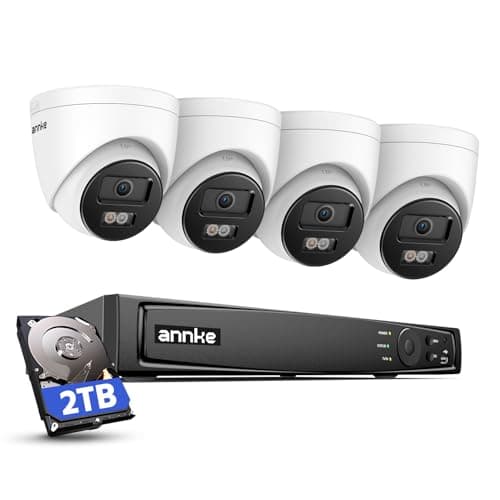
The ANNKE 8CH 4K PoE system is the value entry into wired surveillance. Where most cameras we cover are wireless, subscription-shaped consumer gadgets, this is professional-style infrastructure sold at a friendly price: four 8MP turret cameras, an eight-channel network video recorder, and a 2TB hard drive, all in one box, designed to bolt to your house and record everything, all the time, with nobody ever billing you. It asks for real install work and it hands you a plainer app than the big consumer brands - but for the money, very little else records four sharp 4K cameras around the clock for a one-time cost.
What a PoE turret kit actually is
The character of this system comes down to two things: PoE and turret cameras. PoE - Power over Ethernet - means each camera connects to the recorder with a single Cat-5e cable that carries both its power and its video. That one detail fixes the two things people quietly hate about wireless cameras: there is no battery to recharge and no outlet to hunt for near each camera, and there is no Wi-Fi signal to drop, because the video travels down copper rather than through congested 2.4GHz airspace. A wired-in camera simply does not fall offline the way a battery cam on a weak signal does. If you want the fuller argument for going wired, our wired vs wireless guide lays out the trade in detail.
The turret part is the camera form factor. Turret cameras are the compact, eyeball-in-a-cup style - they sit closer to the wall than a protruding bullet camera, which makes them harder to knock out of alignment and less prone to the internal glare and spiderwebs that can plague a bullet's recessed lens. They are visible and fixed: they point where you aim them and they announce that the house is watched, which is part of the deterrent. For covering the defined approaches to a home - the driveway, the front and back doors, a side gate - four fixed turrets is a sensible starting layout.
24/7 recording to a drive you own - and no subscription, ever
Here is where the ANNKE kit pays back the install work. Because the recorder ships with a 2TB drive already installed, all four cameras record continuously, 24 hours a day - not just short motion clips, but a genuine round-the-clock timeline you can scrub back through. And it does that with no subscription of any kind: no cloud plan gating your footage, no monthly fee to keep more than a few hours, no feature held hostage behind a paywall. The footage lives on your drive, in your house, and it is yours.
That is a fundamentally different value proposition from the wireless cameras that dominate the category. A battery camera on a cloud plan gives you motion clips for as long as you keep paying; this system gives you everything, always, for a one-time hardware cost. Over a few years the difference is enormous, and it is the reason PoE systems keep their appeal despite the effort. If a recurring bill is what you are trying to escape, continuous local recording is the escape hatch - and our local vs cloud storage guide explains the trade-offs of keeping footage at home versus in the cloud. If you would rather stay wireless but still avoid fees, our best no-subscription cameras page is the detour.
The cameras: 4K turret detail
The four cameras are 8MP - that is 4K - which is a lot of resolution for a home system: enough to make a face or a license plate legible when you crop into the frame, which is exactly the moment lower-resolution cameras let you down. If you are weighing whether that detail is worth it over a cheaper sensor, our 2K vs 4K guide walks through where the extra pixels actually earn their keep and where they do not. On a whole-property wired kit, 4K is the right call, because the cameras are watching the exact spots - gates, driveways, entrances - where you later need to identify who, not just notice that something moved.
ANNKE does not publish every hardware detail the way a consumer brand markets its cameras, so where a spec such as a specific night-vision range or an IP weather rating is not stated on the listing, we treat it as Not listed rather than guess. What the listing does make clear is the core promise: four 8MP turret cameras feeding an eight-channel recorder that captures them all, continuously, to a drive you own. Before you run a single cable, our guide on where to place security cameras is worth reading, because the value of 4K detail is wasted if the camera is aimed at the sky or into a backlit doorway.
ONVIF openness: the underrated feature
One thing that quietly separates ANNKE from the walled-garden consumer brands is that the cameras are ONVIF-friendly. ONVIF is an open industry standard that lets cameras and recorders from different makers talk to each other. In practice that means the ANNKE cameras are not permanently married to ANNKE's own recorder or app - they can be pointed at third-party NVR software or a different recorder down the line. For most buyers that will never matter; they will run the kit exactly as it comes. But for the tinkerer, or anyone who worries about being trapped in one company's software forever, it is real insurance that a closed ecosystem does not offer. It is the difference between owning components and renting an ecosystem.
The honest costs: cabling, four-on-eight, and a plain app
The price of all this reliability is honest labor. You have to run an Ethernet cable from the recorder to each of the four camera positions - drilling, routing cable through walls or along soffits, and mounting the cameras solidly. This is not the five-minute stick-it-up-and-pair experience of a Wyze or a Blink; it is closer to installing fixtures. It is very doable as a DIY project if you are comfortable with a drill and a cable run, but if that idea horrifies you, that alone may point you back toward wireless.
The second honest note is the four-on-eight math. This is an eight-channel recorder that ships with only four cameras, so half the channels start empty. That is genuine headroom - you can add up to four more cameras as your coverage needs grow, which is a real advantage over a sealed four-camera-only kit - but it also means covering a large or oddly-shaped property is not finished out of the box. If you are trying to work out how many cameras a home actually needs, our guide on how many cameras you need helps you plan before you buy the extras. Finally, be clear-eyed about the software: ANNKE's app and NVR interface are utilitarian. They work, and they give you the local timeline and playback that matter, but they are not as friendly or as polished as the consumer apps from Ring, Nest or eufy. You are trading interface polish for price and openness.
The verdict
The ANNKE 8CH 4K PoE system earns its award as the best-value way into a real wired system. It gives you four sharp 4K turret cameras, continuous 24/7 recording to a 2TB drive you own, ONVIF openness, four spare channels to grow into, and no subscription now or ever - at a price that undercuts the fancier kits. The price you pay is the install and a plainer app: an afternoon of running Ethernet and mounting cameras, and the acceptance that the software prioritizes function over friendliness. For the value-minded buyer who wants a genuine fee-free surveillance system and is willing to do the wiring, it is one of the easiest recommendations in the category. If you want a more refined app and documented expansion to twelve cameras, our Reolink RLK8-800B4 review covers the closest rival, and our Reolink vs ANNKE comparison puts the two head to head.
As always, we did not install and stress-test this system in a lab. We compiled its published specs from ANNKE's own Amazon listing, confirmed what the kit includes and how it records, and described the install honestly rather than inventing hands-on results. Where a judgment would need genuine testing, we say so; the full method is on the methodology page, and this system also appears in our best wired systems roundup.