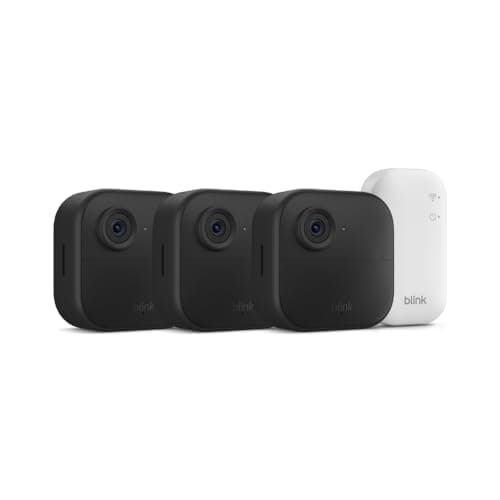
The Blink Outdoor 4 is not trying to win a resolution chart or an ecosystem war. It is trying to do one thing better than almost anything else at its price: go up on a wall, survive the weather, and keep running on a pair of batteries for so long you forget it is there. That is a narrow pitch, but for a lot of homes it is exactly the right one — and this review is about whether it is the right one for you, based only on Blink's published specs.
What you get out of the box
The Outdoor 4 records 1080p HD video with infrared night vision and two-way talk, in a compact IP65-rated body that runs on two AA lithium batteries. It is most commonly sold as a three-camera kit — there is a single-camera option too — which is the heart of its appeal: three weatherproof cameras in one box is a genuinely inexpensive way to cover the front, the back and a side of a house at once. Setup is the familiar battery-camera routine: pair each camera to the included Sync Module, join Wi-Fi, mount, done. There is no wiring to run and no outlet to find, which is the entire reason a battery camera exists.
Image quality is where the budget shows, and we will not pretend otherwise. 1080p is enough to see a person, a package or a car, and to recognize someone you already know at close range, but it is a clear step behind the 2K, 2.5K and 4K sensors on cameras that cost about the same. If you want the sharpest possible footage, the Blink is not that camera — it spends its budget on battery life and a low per-camera price instead. We line it up against the sharper field in our roundup of the best outdoor security cameras, where both its strengths and its 1080p ceiling show clearly.
The two-year battery claim, read honestly
The headline number is the battery: up to two years on a single set of two AA lithium cells, per camera. That is a real figure from Blink, and it is genuinely excellent — but the words "up to" are doing quiet work, and an honest review has to say so. The two-year figure assumes the camera's default, motion-only settings: it wakes, records a short clip when something moves, and goes back to sleep. Point one of these at a busy street or a front door that triggers all day, turn up the clip length, or lean on live view often, and the battery drains faster — potentially much faster. On a quiet side gate that sees a person twice a day, two years is believable. On a busy frontage, plan for more frequent swaps and judge the camera on that, not on the box number.
The upside of AA lithium cells is that a recharge is a two-minute job with no ladder-and-cable ritual and no downtime waiting for a built-in pack to top up — you keep spares, swap them, and the camera is back in seconds. It is a genuinely low-maintenance camera, and that ease is the whole point of the design. Just size your expectations to where each camera is pointed rather than to the single best-case number on the listing.
Storage — the plan, or the Sync Module 2 workaround
This is the part that deserves the most attention, because it is the easiest thing to get wrong at checkout. Every Blink Outdoor 4 kit ships with a Sync Module, but there are two different Sync Modules and they are not equal. The one included with most kits, the Sync Module Core, does not do local storage. With only that module, saving and replaying a recorded clip requires the Blink subscription plan.
There is, however, a real way to avoid the monthly fee entirely: upgrade to a Sync Module 2 and plug a USB drive into it, and the system stores your clips locally with no plan at all. That is a genuine no-subscription path, and it is the reason the Blink earns a place on our best no-subscription cameras page despite being a subscription-brand camera at heart. The catch is that the Sync Module 2 and the USB drive are usually a separate purchase, so the no-fee version of this camera costs a little more up front to set up. Decide which route you want before you buy: the cheap-and-simple Blink plan, or the slightly-more-effort, no-monthly-fee Sync Module 2 with a USB drive.
Either way, know that without one of those two setups the camera gives you a live view and a motion alert but no saved clip to go back to — the same trap as any subscription camera. Treat the storage decision as part of the purchase, not as an afterthought, because a camera that cannot save a clip is only doing half its job.
Weatherproofing, night vision and the fine print
The Outdoor 4 carries an IP65 rating, which means it is fully dust-tight and protected against water jets — comfortably enough for an exposed wall in normal weather, and rated to operate across roughly -4F to 113F. That is a real outdoor rating, not a keep-it-under-the-porch one. There is a catch worth repeating straight from the spec sheet: that weather resistance depends on the port cover staying properly fitted. Leave the cover off or loose and you have compromised the seal, so it is worth a careful look during install and an occasional check afterward.
Night vision is infrared, which means clear black-and-white footage in the dark rather than the color night vision on some pricier rivals. Infrared sees perfectly well — you will make out a figure, a movement, a shape — but you lose the color detail that helps identify a jacket or a car at night. For a lot of buyers that is a fair trade at this price; if reading fine detail after dark is the whole point, it is a reason to look at a color-night-vision camera instead.
Ecosystem: Alexa, and only Alexa
Blink is an Amazon brand, and it behaves like one. The Outdoor 4 works with Amazon Alexa — pull a live feed up on an Echo Show by voice, for instance — and that integration is clean. But it stops there. There is no Google Home support, no Apple HomeKit, and no Matter; Matter camera support has barely started, and Blink does not list it. If your home runs on Alexa, none of this matters and the Blink slots right in. If you are a Google Home or an Apple household, this is a genuine limitation, and it is one of the clearest ways the Blink differs from its own sibling brand — a gap we walk through in Ring vs Blink.
Living with a three-camera kit
The three-camera kit is the configuration most people buy, and it shapes how you should think about placement. Because all three cameras run off a single Sync Module and the same Blink account, you are really setting up one system that happens to have three eyes — a front door, a back garden and a side approach, for example. The smart move is to match each camera to how busy its spot is: put the cameras that see the least traffic where charging is hardest to reach, and keep the busiest one — the front door that triggers all day — somewhere you can get to easily for the occasional battery swap. Two-way talk is on every camera, so you can answer a delivery or warn off a loiterer from the app at any of the three. And because the whole kit is 1080p and infrared, the experience is consistent across every angle: no camera is sharper or sees better in the dark than another, which makes the footage easy to review as one timeline rather than a patchwork of different qualities. It is an unglamorous, dependable way to watch a whole property, and that consistency is a real part of the appeal.
The verdict
The Blink Outdoor 4 is a focused, honest budget camera. It is not the sharpest, it does not speak every smart-home language, and it makes you choose between a monthly plan and a USB workaround to save your clips. But it is one of the cheapest ways to put genuinely weatherproof cameras on every side of a house, and its up-to-two-year battery claim means that once they are up, you can largely forget them. Buy it if you want inexpensive, low-maintenance, whole-property coverage and you either live in Alexa or do not care about the other ecosystems. Skip it if you want the best possible image, or if you need Google or Apple support. Know what it is — a battery-life and coverage specialist, not an image-quality leader — and it becomes very easy to recommend for the job it is built for.