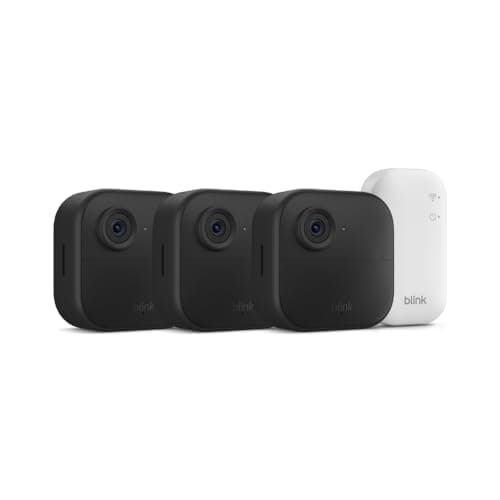
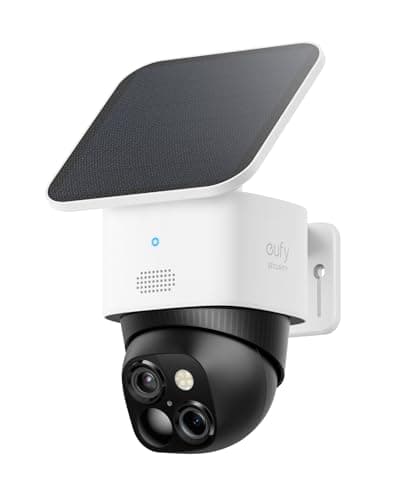
These two get cross-shopped constantly, but they are aimed at different buyers, and naming that is the whole comparison. The Blink Outdoor 4 is the budget play: a small wireless battery camera that gets you into outdoor coverage for very little, works neatly with Alexa, and is sold in multi-camera kits - with the catch that saving clips leans on a Blink Subscription Plan unless you add a Sync Module 2 and a USB drive. The eufy SoloCam S340is the value play: a pricier solar camera with a 3K dual-lens setup, pan-and-tilt for 360-degree coverage, and free built-in local storage with no monthly fee ever. So the real question is not "which is better" but "do you optimize for the lowest sticker price or the lowest cost over years," and that is a question you can actually answer.
The verdict up front
Our winner is the eufy SoloCam S340. Over the life of the camera it simply gives you more for less ongoing cost: a sharper 3K dual camera, pan-and-tilt coverage instead of one fixed view, a solar panel that keeps it charged, and - the decisive part - footage stored free on the device with no subscription. For most people who plan to keep a camera running for years, no-fee local storage plus solar is the better deal, which is why it takes the top pick.
The Blink Outdoor 4 wins one thing cleanly and it is a big one: the lowest way in. If your priority is the cheapest possible upfront cost, you want to cover several spots at once with a multi-camera kit, or you live deep in Alexa and value that tight integration, the Blink is the right call - as long as you go in knowing that keeping saved clips means either a Blink plan or the one-time cost of a Sync Module 2 and a USB drive for local storage. It is not a compromise for that buyer; it is the correct tool.
Resolution and coverage: the sharpest gap
This is where the two diverge most. The eufy is a 3K dual camera - a wide lens and a telephoto - that pans and tilts to sweep a full circle, so one unit can cover a scene with no blind spots. The Blink is 1080p HDwith a single fixed lens, which watches its one frame and does it for far less money. If identifying faces and plates or covering a broad area from a single mount matters, the eufy is in a different class; if you just need eyes on a specific spot and price rules, the Blink's 1080p is enough. For the wider debate on how much resolution actually helps, see our 2K vs 4K guide.
Power: battery vs solar
Both are wire-free, but they handle power differently. The Blink runs on batteries the listing rates at up to two years, so you mount it and largely forget it until a battery swap comes due. The eufy pairs its battery with an included solar panel, so in a sunny spot it tops itself up and you rarely think about charging at all. Both give you go-anywhere placement with no power cable; the difference is that the eufy leans on the sun to stay topped up while the Blink leans on a long battery life between swaps. Neither needs an outlet, which is the point of this whole category - and the broader trade-offs live in our wired vs wireless guide.
Storage and fees: the decision that pays off for years
Here is the heart of it. The eufy has built-in 8GB local storage and states no monthly fee- your footage lives on the camera and you owe nothing to keep it. The Blink's saved-clip story is more conditional: to keep recorded clips you either subscribe to a Blink Subscription Plan for cloud storage, or you add a Sync Module 2 and a USB driveto store clips locally without a fee. That means the Blink can be fee-free too - but only if you buy and set up the local-storage hardware, which the eufy bundles into the camera itself. Over several years this is where the "cheap" camera can quietly become the expensive one, and it is exactly why we run the numbers-free honesty on our subscription costs and local vs cloud storage pages. If avoiding a fee entirely is the goal, both can do it, but the eufy does it out of the box.
Weatherproofing and ecosystem
Outdoors, both are built for the weather, with the eufy rated IP67 and the Blink IP65 - both weather-resistant, with the eufy a step higher on paper. On ecosystem, the Blink is the clearer fit for one platform: it works with Alexa, so it drops into Alexa routines and smart displays. The eufy's listing does not name Alexa, Google or Matter, so if voice and smart-display integration is central to your setup, that is a real point for the Blink. Neither listing names Matter. As always we only credit what each maker actually documents - the matrix below is that, and nothing invented.
So which one?
Want the best camera for the money over years - sharper 3K, pan-and-tilt coverage, solar power, and footage stored free with no fee? Buy the eufy SoloCam S340. Want the lowest upfront cost, a multi-camera kit to blanket several spots, or deep Alexa integration, and you are fine either paying for a Blink plan or adding a Sync Module 2 and a USB drive for local clips? Buy the Blink Outdoor 4. There is no universally "better" camera here - there is the value pick and the budget pick, and which is right depends on whether you optimize for the sticker or the years after it. Both sit in our best wireless cameras roundup, the eufy also appears among the best solar cameras and no-subscription cameras, and each has a dedicated review (eufy / Blink). If you are also weighing the eufy against another solar contender, our Reolink Argus 4 Pro vs eufy SoloCam S340 comparison is the next stop.
The honest caveat, the same on every page here: we did not lab-test either camera. The specifications above - resolution, power, storage, weather ratings and ecosystem - were read from the Amazon listings and manufacturer documentation on August 1, 2026, and reflect what each maker claims, not our own bench testing. Where a judgment would need hands-on time, we say so; the full method is on the methodology page.