Update, 2 October 2026 - the Reolink side of this comparison is no longer stocked on Amazon. The single-camera Argus 4 Pro has been delisted in black and reads "Currently unavailable" in white; on Amazon it survives only inside Home Hub and multi-camera bundles. Reolink still sells it direct, so this is a stocking change rather than a discontinued product - but we have removed its buy link from this page rather than send you to a dead listing, and the eufy is the only camera here you can buy through us today.
The comparison is left intact because the trade it explains - a fixed wide lens against a motorised head - is the real decision in this category and has not changed. If it is the Reolink side you want, note that our current Reolink pick, the Argus PT Ultra, sits on thesame side of that trade as the eufy: it pans and tilts too. It brings 4K and a 512GB card slot where the eufy brings a telephoto lens and 8GB built in.
The Reolink Argus 4 Pro and the eufy SoloCam S340 are the two cameras a no-subscription shopper keeps landing on once the budget stretches past the $30 tier. Both hover around $200. Both are wire-free, both charge from the sun, and both record locally with no monthly fee - the whole reason a cost-conscious buyer looks past Ring and Blink in the first place. They even share the same headline promise: free on-device detection of the things that matter, with no plan to buy. Where they split is not price or fees - it is how they cover ground, and that single difference should decide which one goes on your wall.
The one difference that decides it: fixed wide view vs. pan, tilt and zoom
The Argus 4 Pro is a fixed camera with an unusually wide eye. Two 4K lenses are stitched into a single 180-degree panorama, so from one mount it takes in an entire driveway, frontage or back fence in a single 8-megapixel shot. It does not move. Its advantage is that it is never pointed the wrong way: whatever happens anywhere in that 180-degree arc is recorded, in 4K, the instant it happens.
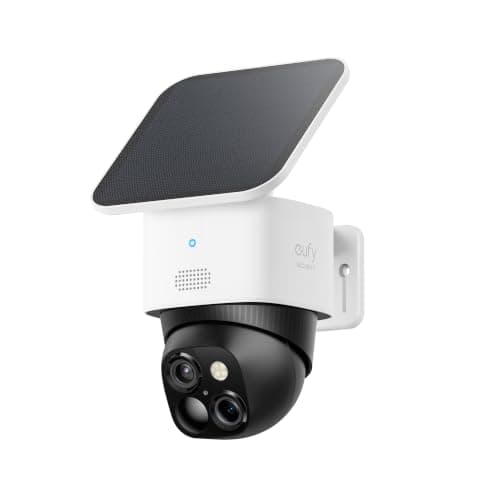
The SoloCam S340 takes the opposite approach. It is a motorized camera that pans 355 degrees and tilts 70, and it carries two lenses of its own - a 3K wide-angle to watch the scene and a 2K telephoto that zooms in (hybrid 8x) to read detail up to roughly 40 feet away. Set it to track, and it physically swings to follow a person moving across the yard, then leans on the telephoto to pull in a face or a plate the wide lens would leave as a smudge. Its advantage is reach and detail: it can cover a very large area over time and zoom into things a fixed lens simply cannot.
The catch is the mirror image of each strength. The Reolink cannot zoom in or swivel - what its 180-degree lens sees at its native resolution is what you get. The eufy, because it points one way at a time, can be aimed at the side gate while someone crosses the driveway behind it; auto-tracking helps, but a motorized camera physically cannot watch two directions at once the way a fixed 180-degree lens can. Neither is "better" in the abstract. A wide fixed lens is the safer default for guaranteed coverage of one area; a pan-tilt-zoom camera is the better tool when you need to actively follow motion and read distant detail.
Storage: expandable card vs. fixed built-in memory
This is the second real gap, and it favors the Reolink. The Argus 4 Pro takes a microSD card up to 512GB, or you can point several Reolink cameras at a Reolink Home Hub for centralized local storage - either way with no subscription. That means you decide how much history to keep: size the card to your habits and you can hold weeks of footage before anything is overwritten.
The SoloCam S340 has no card slot at all. It records to 8GB of built-in memory, and that is the ceiling. For a quiet camera that captures a handful of events a day, 8GB is fine and refreshingly simple - nothing to buy, nothing to insert. But on a busy camera watching a public sidewalk, 8GB fills fast, and once it is full the oldest clips are overwritten whether you have reviewed them or not. There is no expanding your way out of it. If "scroll back several days" matters to you, the Reolink's expandable storage is a genuine advantage; if you only ever check the last clip or two, the eufy's no-card simplicity is a feature, not a flaw.
Night vision, resolution and the image itself
Both cameras see in color after dark rather than the usual ghostly infrared gray, but they get there differently. Reolink's ColorX pairs a large sensor with a bright lens and small spotlights to hold true color in low light, and in the 4K panorama that adds up to the sharper, more detailed night image of the two. The eufy's color night vision is capable in its own right, and its telephoto lens can out-reach the Reolink on a specific far-away subject by zooming in - but across the whole scene, the Argus 4 Pro's 4K resolution and ColorX give it the edge for reading detail at a distance without moving the camera. If your priority is one crisp, wide, low-light shot of everything, the Reolink wins the image; if it is pulling a distant subject in close, the eufy's zoom answers back.
What comes in the box, and what you still have to buy
Both are wire-free and both are built to run on the sun, but the packaging differs in a way that affects the real price. The eufy includes its 2.2W solar panel in the box and needs no memory card, so the $200 you pay is close to the whole cost - unbox it, mount it, done. The Reolink is more of a platform: the camera has a rechargeable 5000mAh battery, but its solar panel is frequently a separate or bundled add-on rather than a guaranteed inclusion, and you will want to buy a microSD card to give it the local history that is one of its main strengths. Neither camera charges you a monthly fee - that promise is identical - but the eufy is the more genuinely all-in-one purchase, while the Reolink asks for a card (and possibly a panel) on top. Check the exact listing before you buy so you know which box you are getting.
Ecosystem, and the Apple question
Here the two are twins. Both work with Amazon Alexa and Google Assistant, so you can pull up a live feed on an Echo Show or a Nest Hub either way. Neither supports Apple HomeKit, and neither speaks Matter, whose camera support has barely started, as our Matter vs Thread vs Zigbee guideexplains - so an Apple Home household would be viewing each of these through its own app rather than in Apple Home. If cross-ecosystem tidiness is the priority, that is a reason to widen the search; both of these live in their maker's app plus Alexa or Google, and no further.
The usual honest caveat applies, the same one on every page here: we did not wire these two cameras into a test rig. We read each camera's published specifications and the manufacturers' own documentation on resolution, storage, power and detection, and compared them straight. Where a figure would have to come from hands-on testing, we say so rather than inventing it.
How to actually choose
Start with the shape of what you are watching. If it is one broad area - a driveway, a frontage, a back garden - that you want covered completely and continuously, buy the Reolink Argus 4 Pro. Its fixed 180-degree, 4K lens sees the whole space at once and is never aimed the wrong way, and the expandable microSD storage means you can actually scroll back days or weeks. It is the more foolproof security camera of the two on paper - but since October 2026 Amazon no longer lists it as a single camera, so that route means buying direct from Reolink.
When the eufy is the right call
Buy the eufy SoloCam S340 if your problem is reach and detail rather than blanket coverage: a large or awkward yard where you want the camera to swivel and follow a person, and a telephoto lens to zoom in on a face or a package across the lawn. It is also the more truly all-in-one box - the solar panel is included and there is no card to buy - so if you want to mount it and forget it with nothing else to purchase, the eufy gets you there in one order. Just go in knowing the 8GB built-in memory is fixed, and that a pan-tilt camera watches one direction at a time.
Where they agree - and what that means for cost
Both cameras keep the promise that brought you here: local recording, free on-device person and vehicle detection, and no monthly bill ever. That is worth holding onto, because a subscription camera's fee compounds - our breakdown of what camera subscriptions really cost shows how a "cheap" cloud plan can outrun a pricier no-fee camera over three years. Between these two it is not the deciding factor, since neither charges you - but it is the reason both belong on the same shortlist as the rest of our no-subscription camera picks, where the eufy leads the broader field on buy-and-forget simplicity and the Reolink Argus PT Ultra now stands out for 4K detail and the most local history.