Cameras · Security Cameras
Reolink Argus 4 Pro Review: One Camera That Sees the Whole Front
The Argus 4 Pro is a 4K, 180-degree solar camera that stores footage locally with no subscription. It's the pick when you want one wire-free camera to cover a whole frontage - here's the honest picture.
We earn a commission when you buy through our Amazon links, at no extra cost to you. It never changes our rankings — where the subscription-free or cheaper option is the better buy, we say so. How this works.
Verdict
The bottom line
The Reolink Argus 4 Pro is still the best answer to one problem — covering a whole frontage from a single wire-free mount — because it stitches two lenses into one 180-degree, 8-megapixel frame and records to a 512GB card or a Reolink Home Hub with no subscription. The catch as of 2 October 2026 is that Amazon no longer stocks it as a single camera; Reolink sells it direct. If you want the closest camera you can order today, buy the Reolink Argus PT Ultra— same 4K/8MP, same solar and no fee, same 512GB card slot, but it covers wide ground by panning 355 degrees rather than seeing it all at once. If you'd rather have a telephoto lens and storage built in, the eufy SoloCam S340 is the other way to solve it.
Side by side
The Argus 4 Pro and the two cameras we can actually send you to
- Reolink Argus 4 Pro
Best for: A whole frontage in one fixed 180-degree frame
- 8MP (5120×1440) at 15fps
- 180° horizontal dual-lens
- ColorX — no infrared
- microSD to 512GB / Home Hub
- IP66 · 5000mAh + solar
No single-camera Amazon listing — Reolink sells it direct
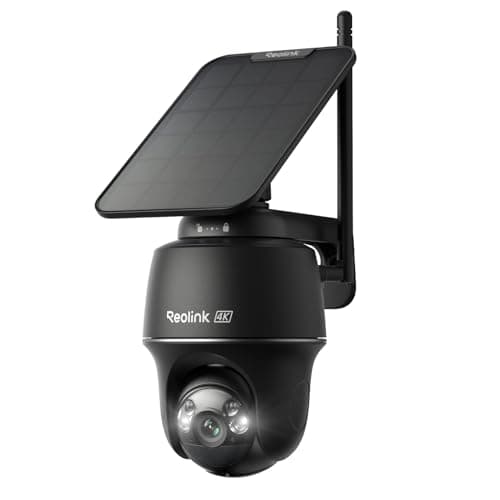 Reolink Argus PT UltraBuy this one
Best for: The Reolink you can buy today: 4K that turns to follow motion
- 4K / 8MP (3840×2160) at 15fps
- 355° pan, 140° tilt + auto-tracking
- 110° diagonal lens
- microSD to 512GB / Home Hub / FTP
- IP65 · 21.6Wh + 3W panel included
$127.99View on Amazon$159.9920% off
#ad · we may earn a commission from this link to Reolink Argus PT Ultra
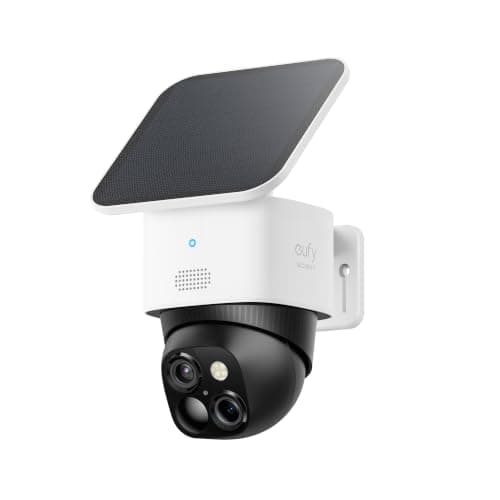 eufy SoloCam S340
Best for: Pan-tilt plus a telephoto lens, with storage and solar in the box
- 3K wide (2880×1620) + 2K telephoto
- 360° pan / 70° tilt, 8× hybrid zoom
- 135° field of view
- 8GB built-in eMMC — no card to buy
- 2.2W solar panel included
$159.99View on Amazon$199.9920% off
#ad · we may earn a commission from this link to eufy SoloCam S340
#ad · Specs as published by the manufacturer, read 2 Oct 2026. Live prices from the Amazon Product API, as of October 24, 2026. Where we have no verified live price we show none.
Update, 2 October 2026 - no longer stocked on Amazon. Amazon has delisted the black Argus 4 Pro and the white unit now reads "Currently unavailable". On Amazon the camera survives only inside Reolink Home Hub and multi-camera bundles. Reolink still sells it direct, so this is a stocking change rather than a discontinued product - but we have no live single-camera listing to send you to, so the buy link has been removed from this page.
The Reolink we can point you to instead is the Reolink Argus PT Ultra: also 4K, also solar with the panel in the box, and it takes a microSD card up to 512GB. It is not the same camera, and we will not pretend otherwise - it covers a wide area by panning 355 degrees rather than by stitching two lenses into one fixed 180-degree frame. The review below stays up as a reference for anyone comparing the two.
Most security cameras make you choose between two things you actually want: a sharp image and a wide view. Push the resolution up and the lens narrows; widen the lens and detail smears at the edges. The Reolink Argus 4 Pro is Reolink's answer to that trade - a dual-lens design that stitches two sensors into a single 4K, 180-degree frame, on a solar body that records to local storage with no monthly fee. On paper it is one of the few wire-free cameras that promises to watch a whole frontage without giving up sharpness. This review is about how well that promise holds up, and who it is genuinely the right camera for.
The wide view is the whole point
The headline spec is the one that matters: 8 megapixels across a 180-degree field of view — 5120 by 1440 pixels, which Reolink markets as 4K — produced by two 4mm lenses that the camera merges into one panoramic image. That combination is unusual. A normal fixed camera at this resolution sees maybe a 110- to 130-degree slice, which means a corner of the drive or the far side of a porch sits outside the frame. The Argus 4 Pro is built to hold a whole frontage - a driveway, a wide garden, a double gate - from a single mount, and to do it in enough detail that you can still make out a face or a number plate near the center. For a lot of homes that is the difference between one camera and two, which is a real saving even before you count the wiring you don't have to run.
There is an honest caveat to the dual-lens approach, and it is the camera's main weakness: where the two lenses meet, the stitching can show a faint seam on a subject standing close to the camera. At a distance - which is where most of the frame lives - it is invisible, but a person walking right up to the lens can cross the join and look very slightly misaligned for a moment. It is a cosmetic quirk rather than a coverage failure, and it is the price of getting 180 degrees and 4K out of one unit, but you should know it is there before you buy.
Solar and battery: mount it and forget the cable
The Argus 4 Pro runs on a rechargeable battery and ships to charge from a solar panel, which is what makes it a genuine wire-free camera rather than a wired one pretending. In a spot with decent sun, the panel tops the battery up faster than a normally busy camera drains it, so in practice you mount it once and stop thinking about power. That matters most for exactly the locations a wide camera is good at - the far corner of a drive, a gate at the end of a path - because those are the spots least likely to have an outlet nearby. If the mount is shaded or the camera is extremely busy, you can still recharge the battery by cable, the same way you would any battery camera. Our best outdoor security cameras roundup ranks the weatherproof field you can currently buy, with the Argus PT Ultra in this camera's former slot.
Built for the weather
The body carries an IP66 weatherproof rating, which means it is fully dust-tight and rated against powerful water jets - comfortably enough for a fully exposed wall that catches driving rain, not just a spot tucked under an eave. That is an important distinction outdoors, where some cameras marketed as "weather-resistant" really want some cover. The Argus 4 Pro does not; you can put it on an open frontage and leave it through the seasons. As with any outdoor camera, the rating holds within the maker's operating temperature range and assumes the unit is mounted as intended, so it is worth a look at the install instructions rather than just the box - but IP66 is a serious, weatherproof-in-the-open rating.
Night vision that stays in color
Reolink calls its low-light system ColorX, and the point of it is that night footage stays in color rather than dropping to the gray of classic infrared. That is more useful than it sounds: the color of a jacket or a car is often the detail that actually identifies someone, and it is exactly the information black-and-white infrared throws away. Most break-in worry is after dark, so for an outdoor camera the night image is arguably more important than the daytime one, and keeping it in color is a genuine advantage over the infrared-only cameras it competes with.
No subscription, and no asterisk
This is the part that separates the Argus 4 Pro from the big-name cloud cameras, and it is worth being precise about. The camera records to a microSD card or to a Reolink Home Hub, and neither needs a subscription - the recorded clips are yours, stored in your house, with no monthly bill to review them. That is not true of every camera at this level; some show you a free live view but charge a fee the moment you want to see what happened while you were out. The Argus 4 Pro does not play that game. If you would rather centralize several Reolink cameras' footage in one place, the Home Hub does that locally; if you just want the simplest setup, a microSD card in the camera is enough. Either way the running cost is nothing - the same reason its replacement leads our best no-subscription cameras list, where the three-year cost math is already done.
One ecosystem note before you buy: the Argus 4 Pro does not support Matter or Apple HomeKit Secure Video - Matter camera support has barely started across the board - so you will live in the Reolink app plus Alexa or Google Home. That is the same story as almost every camera in this class, and it changes nothing about the no-fee promise, but if a camera inside Apple Home is a hard requirement, this is not the one.
Where it fits, and where it doesn't
The Argus 4 Pro is a specialist that happens to be excellent at its specialty. If your problem is a wide frontage, a driveway, or any spot where one camera has to see a lot of ground in real detail and there is no power nearby, it is close to the ideal answer: 4K, 180 degrees, solar, weatherproof, and free to record. If your problem is a narrow side gate, a doorway, or you want a camera that hides, it is the wrong tool - the wide lens is wasted on a tight view and the body is genuinely large and visible. Its closest rival is a pan-and-tilt camera that covers a wide area a different way, by physically turning to follow motion rather than seeing it all at once; we put the two side by side in Reolink Argus 4 Pro vs eufy SoloCam S340, which is the comparison to read if a wide yard is your problem.
The verdict
The Reolink Argus 4 Pro did one thing nothing else wire-free did as cleanly: it turned two cameras' worth of coverage into one 4K, 180-degree unit that charges from the sun and records for free. The faint stitching seam on close subjects and the frankly large body were real trade-offs, but they were the right trade-offs for the buyer it was aimed at - someone who wants maximum coverage from one mount and does not care whether the camera is discreet. If that is you, it is still the right shape of camera; you will just have to buy it from Reolink directly, because Amazon no longer lists it on its own. If a pan-tilt head and a 512GB card slot would serve you just as well, the Argus PT Ultra is the Reolink we can point you to, and the best home security cameras roundup ranks the full current field on true three-year cost.
Questions
Frequently asked
Does the Reolink Argus 4 Pro require a subscription?
How does the 180-degree dual-lens view actually work?
Is the Argus 4 Pro fully weatherproof for an exposed wall?
Do I need to keep the solar panel in direct sun?
Does it work with Apple HomeKit or Matter?
Can you still buy the Reolink Argus 4 Pro?
What should I buy instead of the Argus 4 Pro?
What is the difference between the Argus 4 Pro and the Argus PT Ultra?
Does the Argus 4 Pro have infrared night vision?
Keep reading
Related
- Reolink Argus PT Ultra reviewThe Reolink we can point you to buy instead: 4K on a pan-tilt head, 512GB of card space.
- Reolink Argus 4 Pro vs eufy SoloCam S340Its closest wide-view rival, head to head.
- Best no-subscription camerasMore cameras that record with no monthly fee.
- Best home security camerasThe full field, ranked on true 3-year cost.
- eufy SoloCam S340 reviewThe other way to cover a wide yard: pan-tilt with a telephoto lens and storage in the box.
- Night vision cameras, explainedWhy the Argus 4 Pro skips infrared entirely, and when that is the right call.
Receipts
Sources
- Amazon product listings — Reolink Argus PT Ultra and eufy SoloCam S340 (live prices)(read 2026-10-02)
- Reolink — Argus 4 Pro specifications (5120×1440 / 8MP, 180° horizontal, dual 4mm lenses, ColorX with no IR, microSD to 512GB, IP66, 5000mAh)(read 2026-10-02)
- Reolink — Argus PT Ultra specifications (3840×2160 / 8MP, 355° pan / 140° tilt, 110° diagonal lens, microSD to 512GB, IP65, 21.6Wh)(read 2026-10-02)
- eufy — SoloCam S340 specifications (3K 2880×1620 wide + 2K telephoto, 360° pan / 70° tilt, 8GB eMMC, 2.2W solar panel)(read 2026-10-02)
We do not run a test lab, and we do not pretend to. Compatibility and subscription-cost claims come from the manufacturer's own documentation and the live retailer listing, read on the dates shown. Read our full method.