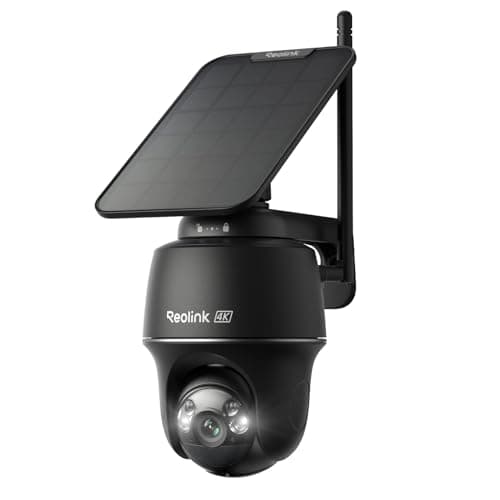
There are two honest ways for one camera to cover a lot of ground. It can stretch its lens until a whole frontage fits in a single frame, or it can sit on a motor and turn to look at whatever just moved. The Reolink Argus PT Ultra takes the second route, and it does something unusual while doing it: it keeps the resolution at a genuine 4K. Cameras that pan and tilt almost always trade pixels for movement, which is why most of them land at 2K or 3K. This one claims 3840x2160 on a 1/2.7-inch sensor, puts a detachable solar panel in the box, and takes a microSD card up to 512GB with no subscription anywhere in the deal. This review is about whether that combination holds together, and who it is genuinely the right camera for.
Turning instead of stretching
The spec that defines this camera is its movement: Reolink publishes 355 degrees of pan and 140 degrees of tilt, which between them account for essentially everything a wall-mounted camera could want to look at. The lens behind that is not wide - it is a fixed 90 degrees horizontal, 110 degrees diagonal - and that is the trade worth understanding before you buy. A fixed ultra-wide camera sees the whole scene all the time and never has to decide where to point. A pan-tilt camera sees a smaller slice in much more detail, and relies on auto-tracking to swing that slice onto whatever matters.
In practice that means two different kinds of footage. On a fixed wide camera, an event that starts at the edge of the drive is in frame from the first second, just small. On the PT Ultra, the same event is caught a beat later but much larger and sharper once the head has moved onto it. If what you need is a readable face or a legible plate, the second is usually the more useful clip. If what you need is a complete record of everything that happened across a wide area at once, the first is. That single distinction decides this purchase more than any other spec on the page.
The storage is the quiet headline
Most wire-free cameras ship with a small, fixed amount of built-in memory and quietly expect you to pay for the cloud when it fills. The PT Ultra does the opposite: Reolink publishes microSD support up to 512GB, plus the option to send footage to a Reolink Home Hub, an NVR or your own FTP server, and none of those routes carries a monthly fee. That is the difference between a camera that shows you last week and a camera that shows you last quarter. It is also the reason this camera sits at the top of our best 4K security cameras roundup: 4K footage is large, and a camera that records in 4K without somewhere to put it is only half a product.
The honest caveat is that the card is not included. Budget for it, and buy more than you think - a 4K camera recording events across a busy frontage will work through storage faster than the spec sheet makes it sound. The local versus cloud storage guide walks through how continuous versus event-only recording changes those numbers.
Solar, and what Reolink actually claims about it
The 3W panel is detachable and in the box, which matters more than it sounds: a bundled panel is the difference between a camera you mount once and a camera you bring down to charge. Reolink's own claim is that roughly twenty minutes of sunlight a day keeps the camera running, on a 21.6Wh rechargeable battery. We take that as a best-case figure, because Reolink also publishes the honest qualifier that battery life varies with settings, usage and temperature - and a pan-tilt head that physically moves on every trigger is a bigger draw than a fixed camera.
The practical reading: in a spot with real daily sun and normal traffic, this is a mount-and-forget install. In deep shade, or on a view that triggers constantly, expect to bring it in occasionally. That is true of every solar camera, and it is why we say the same thing on the best solar cameras roundup: check the light at the exact mounting spot before you check the spec sheet.
Night, weather and deterrence
Night vision runs two ways here. There are two 2.4W spotlights at 6500K, which hold colour in low light out to around ten metres, and two 1.2W 850nm infrared LEDs for everything beyond that or for when you would rather the camera stayed dark. Colour is the more useful mode for identification - the colour of a jacket or a car is often the detail that actually names someone, and plain infrared throws it away - but having the infrared fallback means the camera is not useless on an unlit back fence.
The body carries an IP65 rating: dust-tight and protected against water jets. That is a genuine outdoor rating rather than a splash rating, suitable for an exposed wall, though it is a step below the IP67 immersion rating on some rivals. Alongside the recording there is a siren and two-way audio, so the camera can intervene rather than only witness - a real difference from the purely passive cameras in the same price band. Reolink lists person, vehicle and pet detection with configurable zones on top of PIR, which is how you keep a camera on a windy street from alerting all night.
Where it fits, and where it doesn't
The PT Ultra is the camera for a driveway, a back garden or a yard where you want detail you can actually use and a history you can actually scroll. It is not the camera for a spot where the action is over in two seconds at the edge of the frame, and it is not the camera for someone who wants to buy nothing else - it wants a card. Its closest relative on this site is the eufy SoloCam S340, which also pans and tilts and also records locally with no fee, but ships 8GB of built-in storage instead of a card slot and shoots 3K rather than 4K. If you want the complete field ranked on real three-year cost, start with the best home security cameras roundup.
The verdict
The Reolink Argus PT Ultra earns its place because it refuses the usual compromise: it moves and it keeps the pixels. Auto-tracking on a 4K sensor, a panel in the box, a siren and two-way audio, and 512GB of card space with no subscription is a lot of camera for a wire-free mount, and the limitations are the honest kind - a narrower lens than a fixed ultra-wide, a battery figure Reolink sensibly declines to pin down, and a card you buy yourself. If your problem is detail and history on one spot with no power nearby, this is an easy recommendation. If your problem is seeing a whole frontage in one unbroken frame, buy a fixed ultra-wide camera instead.