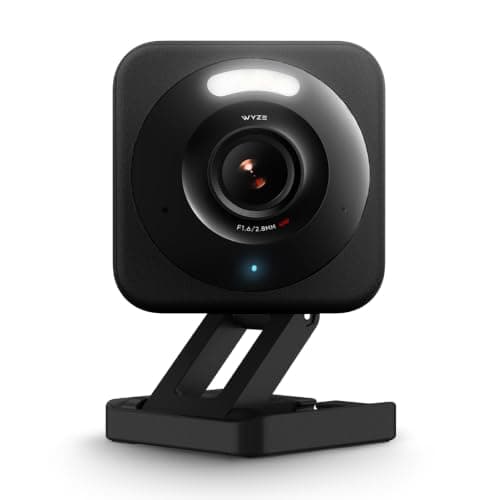
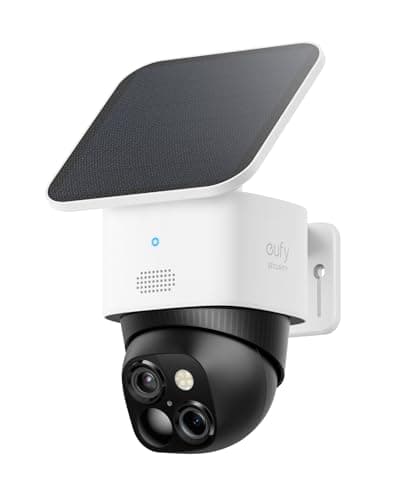
These two get compared as budget-friendly outdoor cameras, but they solve the problem in opposite ways, and that is the whole decision. The Wyze Cam v4 is a wired camera: cheap, sharp at 2.5K, and it records free to a microSD card - but it has to reach an outlet. The eufy SoloCam S340 is a wireless solar camera that pans and tilts to cover 360 degrees and stores footage on 8GB built in, with no monthly fee - but it costs more. So "which is better" is really "is there power where you want the camera," and how much coverage and freedom you are willing to pay for. Answer that and the winner is usually obvious.
The verdict up front
This one is genuinely buyer-dependent, but our pick is the eufy SoloCam S340 for the buyer who wants a camera to just cover an area with no strings attached. Because it runs on solar, you can mount it anywhere - a fence, a gable, a far corner no outlet reaches - and forget about charging in a sunny spot. Its pan-and-tilt head sweeps 360 degrees so a single unit has no fixed blind spot, the 3K dual-camera pairs a wide view with a telephoto for detail, and the 8GB built in means no subscription. For flexible, no-fee coverage of a wide space, it is the more capable camera and worth the extra money.
The Wyze Cam v4 wins cleanly in one very common situation: you have an outlet roughly where you want the camera and you want to spend as little as possible. For the lowest price here you still get 2.5K video, vibrant color night vision, free microSD recording with no subscription, and support for both Alexa and Google Home. It is wired, so placement is limited to where a cable can reach power, and its smart AI alerts are a paid Cam Plus add-on - but as a cheap, capable camera near a socket, nothing on this page beats it on value. Both cameras also sit in our best outdoor cameras roundup.
Power and placement: the real deciding factor
Start here, because it settles most of the choice. The Wyze is wired - it needs a nearby outlet, and that constrains where it can go. The upside of a constant power feed is that it can record continuously rather than only on motion, and there is never a battery to charge. The eufy is the opposite: solar and wireless, so it goes wherever the view is best and the panel keeps it topped up, with no cable at all. If your ideal mount is a spot with no power - a shed, a gate, a tree line - the Wyze is simply off the table and the eufy is the answer. If your ideal mount happens to be near a socket, the Wyze's wired reliability becomes an advantage rather than a limit. Our wired vs wireless guide works through this trade in depth, and the best solar cameras page covers the wire-free, self-charging category the eufy belongs to.
Coverage: fixed lens vs pan-and-tilt
The eufy's headline trick is motion. Its pan-and-tilt head can rotate to cover 360 degrees, and its dual-camera design pairs a wide-angle view with a telephoto for closer detail - so one unit watches a whole yard and can pick out something farther away. The Wyze is a single fixed lens: it sees a wide but stationary field, and whatever falls outside that frame is simply not recorded. For a broad area or a spot where you want one camera to do the work of two, the eufy's pan-tilt and dual lenses are a real advantage. For a doorway, a driveway, or any scene that fits in one frame, the Wyze's fixed view is perfectly adequate and much cheaper.
Resolution and night vision
Both are sharp. The eufy shoots 3K and the Wyze 2.5K, so the eufy has a modest resolution edge that helps when you crop into detail, aided by its telephoto lens. At night, both list color night vision - the eufy lists color night vision and the Wyze lists vibrant color night vision - so neither drops to plain black-and-white by default the way an infrared-only camera does. Color at night is more useful for identifying clothing or vehicles, but it generally wants some ambient light to work with, which is worth keeping in mind for a truly dark mount. Our night vision guide explains what each style of night vision actually needs, and the 2K vs 4K explainer covers how much resolution differences show up in practice.
Storage, fees and the fine print
Both keep footage local and both avoid a mandatory subscription, which is a point in each camera's favor. The eufy stores to 8GB built in with no monthly fee - simple, self-contained, nothing to add. The Wyze records free to a microSD card, also with no subscription for storage. The one asterisk is on the Wyze's smart features: its smart AI alerts (the kind that tell person from pet from vehicle) require a paid Cam Plus plan. So the Wyze is free to record but not free to get the clever alerts, while the eufy bundles its detection with the hardware. If avoiding every recurring fee is the goal, both qualify - just know the Wyze's AI is the part behind a paywall. The no-subscription cameras page and the local vs cloud storage guide go deeper on this.
Ecosystem
Here the Wyze has the clear edge on paper: it works with both Alexa and Google Home, so you can pull its feed onto an Echo Show or a Nest display and use it in routines. The eufy SoloCam S340's listing does not name Alexa, Google or Apple Home - it lives in the eufy app. So if you run your home through a voice assistant and want the camera to appear there, the Wyze is the safer bet; if you mostly check a feed in an app, it matters less. Neither lists Matter, which is expected, since Matter does not cover cameras yet - the full rundown is in our camera ecosystem compatibility guide.
So which one?
Need to mount away from power, cover a wide area with one camera, and never pay a fee? Buy the eufy SoloCam S340 - solar freedom, pan-tilt coverage and built-in storage justify the price. Have an outlet where you want the camera and want to spend the least while still getting 2.5K, color night vision, free recording and both Alexa and Google? Buy the Wyze Cam v4. There is no single better camera here - there is the flexible, no-fee, cover-everything pick and the cheap, wired, near-an-outlet pick. Each has a dedicated review (Wyze / eufy), and if the eufy is on your list against other rivals we also compare the Reolink Argus 4 Pro against the eufy.
The honest caveat, the same on every page here: we did not lab-test these cameras. The power, resolution, storage and compatibility points above come from reading each product's Amazon listing and manufacturer documentation on August 1, 2026 - not from our own bench testing. Where a judgment would need hands-on time, we say so; the full method is on the methodology page.