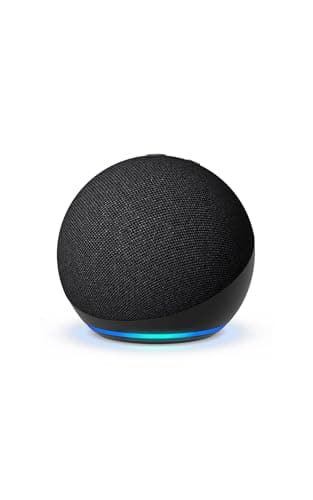
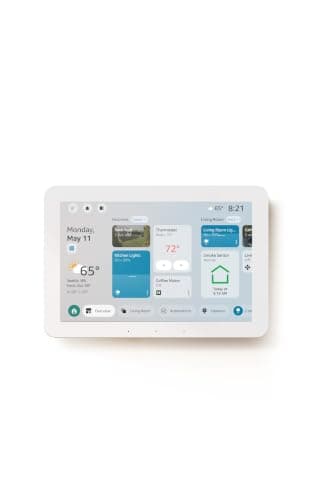
These two both wear the Alexa badge and both get called "smart home" devices, so people line them up as if they were two sizes of the same thing. They are not. The Amazon Echo Dot is a small, inexpensive speaker that also happens to be a Matter controller and quietly reads the room's temperature. The Amazon Echo Hub is an 8-inch panel you mount on a wall, with a real built-in Zigbee hub plus Thread and Matter behind the screen. One is a thing you talk to; the other is a wall you tap. Choosing well is just a matter of knowing which of those jobs you actually have - and it is easy to buy the wrong one expecting the other's strengths.
The verdict up front
There is no single winner, and the honest answer depends entirely on what you want the device to do. If you want a genuine wall dashboard and a built-in Zigbee hub - a fixed surface to see and tap your whole home, plus a radio that can host smart-home devices directly - the Echo Hub is the right buy, and it is the true "hub" of the pair. If you want to add Alexa voice to a room cheaply, put a speaker in several rooms, or simply start with Matter without spending much, the Echo Dot is the smarter buy. Neither replaces the other; they sit at opposite ends of the range on purpose. Both appear in the wider field on our best smart home hubs page.
What each device actually is
The Amazon Echo Hub is a control panel first. It is an 8-inch, wall-mounted screen designed to be the place you glance at and tap to run your home, and crucially it carries a built-in Zigbee hub along with Thread and Matter support. That combination matters: it can host smart-home devices itself, not merely bark voice commands at devices some other hub is running. It is a control surface and a radio in one box. The full Amazon Echo Hub review covers what it can host and how the dashboard behaves.
The Amazon Echo Dot (5th Gen) is a speaker first. It is a compact, affordable Alexa speaker that also acts as a Matter controller and includes a built-in temperature sensor that can feed routines. What it is not is a Zigbee or Thread hub - it has no such radio - so it cannot host those devices the way the Echo Hub can. It is the easy, cheap way to add voice to a room and to step into Matter, and because it is small and inexpensive you can scatter several around the house. The Amazon Echo Dot review goes into what it can and cannot do as a smart-home device.
The question that decides it: dashboard and hub, or voice and price?
Answer one thing and the choice makes itself: do you want a fixed place to see and control your home, with a hub built in - or do you want cheap voice, spread wherever you like? If you picture a panel by the front door showing your lights, locks and cameras that you tap on the way out, that is the Echo Hub, and its built-in Zigbee hub means it can actually run Zigbee devices rather than lean on another box. If you picture "an Echo in the kitchen and one in the bedroom so I can ask about the weather and set timers," that is the Echo Dot, several times over, for the price of one Hub.
A concrete example makes the split obvious. Say you want to add Zigbee bulbs and sensors and control them from a wall panel without buying a separate hub - only the Echo Hub does that, because the Zigbee radio is inside it. Now say you just want voice control in three rooms, the ability to add a Matter plug down the line, and a temperature reading to trigger a fan - three Echo Dots do all of that for less than one Hub, and you get a speaker in every room as a bonus. Same brand, same assistant, very different jobs.
Where they overlap - and where it stops
Both are Alexa devices, so both understand voice, both run Alexa routines, and both touch Matter, which is where the confusion starts. But the overlap stops at a hard line: only the Echo Hub has a built-in Zigbee hub and Thread. The Echo Dot is a Matter controller, which lets it commission and control certain Matter devices, but it cannot host Zigbee or Thread gear because it has no radio for either. So "both do smart home" is true and misleading at once - if you read it as "the Dot can run my Zigbee bulbs," you will be disappointed. Our what is Thread? guide and the Matter vs Thread vs Zigbee explainer make clear why a Matter controller and a device with a Zigbee radio are not the same thing.
The temperature sensor is a smaller overlap-breaker worth naming: the Echo Dot has one built in and the Echo Hub's listing does not name one, so if you specifically want a device that can read room temperature and trigger a routine off it, the cheaper Dot is the one that does it. It is a minor point next to the Zigbee difference, but it is a real one, and it is a rare case where the budget device has a sensor the pricier one does not.
Cost, and the honest recommendation
Price maps straight onto what each device is. The Echo Dot is inexpensive because it is a small speaker with a controller and a sensor inside; the Echo Hub costs more because it is a mounted panel with a real Zigbee hub, Thread and a screen. Buy on the job, not the sticker: a cheap Dot is no bargain if you actually needed a wall dashboard and a hub, and an Echo Hub is money spent on capabilities you will not use if all you wanted was voice in the kitchen. If you are deliberately building out on a budget, our best budget smart home hubs page shows where the Dot genuinely fits and where it does not.
So the recommendation is clean and buyer-dependent. Buy the Amazon Echo Hub if you want a genuine wall control panel with a built-in Zigbee hub, Thread and Matter - it is the real hub here and the better choice for anyone who wants a fixed dashboard and a radio in one. Buy the Amazon Echo Dot (5th Gen) if you want cheap Alexa voice, a speaker in every room, a built-in temperature sensor, and an easy first step into Matter. If you are weighing the Echo Hub against a different kind of hub entirely, our SwitchBot Hub 2 vs Amazon Echo Hub comparison is the next stop, and if you are not sure you need a hub at all, start with do I need a smart home hub?
The usual honest caveat: we did not bench these two side by side. We read each device's own Amazon listing and manufacturer documentation for its radios, roles, screen and sensor, and compared them straight, crediting no capability a listing does not claim. The full method is on the methodology page.