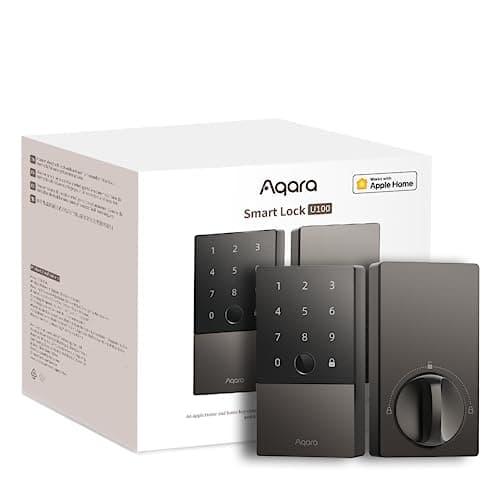
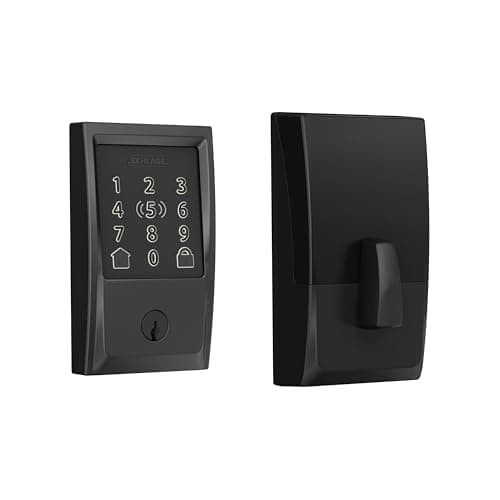
The Aqara U100 and the Schlage Encode Plus answer the same question - "how do I tap my iPhone to unlock my front door without paying a monthly fee?" - and both answer it well. Both carry Apple Home Key, so an iPhone or Apple Watch opens the door with a tap, and both keep every smart feature free of any subscription. If Apple Home Key is your must-have, you genuinely cannot go wrong here. The interesting part is that they get you there by completely different routes, and the route matters more than the destination: one lock builds its connection into the deadbolt, and the other leans on a hub. That single architectural choice ripples out into price, features and how much gear ends up on your shelf.
Both do Apple Home Key - that part is a tie
Start with the shared ground, because it is the reason both locks are on this page. Apple Home Key stores a secure digital key in your iPhone or Apple Watch Wallet, so you walk up, hold the phone near the lock, and it opens - no app to launch, no code to type, and it keeps working even when the phone's battery is nearly flat. Both the U100 and the Encode Plus support it, both show up in the Apple Home app via HomeKit, and both respond to Siri. Neither charges a subscription for any of it. So for an Apple-first home, the tap-to-unlock experience is effectively identical on either lock, and the decision moves entirely to the differences around it. For the wider Apple field, including the keypad-free Level Lock+, our best smart locks for Apple Home roundup ranks all three together.
The core difference: built-in Wi-Fi vs an Aqara hub
This is the sentence that decides most of the comparison. The Schlage Encode Plus has Wi-Fi built into the lock. From the moment you install it, you can lock, unlock and check status from anywhere, and Home Key and HomeKit work, with nothing else to buy. The Aqara U100 is Bluetooth on its own. On the door it does everything locally - fingerprint, keypad, Home Key tap - but for remote access from outside the house, notifications when the door opens, and voice control, it needs an Aqara hub to bridge it to your network. That is real extra hardware to buy and place within range, and it is the honest catch we lead with in the full Aqara U100 review.
Which architecture is "better" depends entirely on your house. If you want the simplest possible path to a Home Key lock you can control from the office, the Schlage wins outright - it is one box and it is done. But if you already run Aqara gear, the hub is likely on your shelf already, the U100 slots straight into an app you use, and the whole objection evaporates. The U100 is at its best as part of an Aqara household; the Encode Plus is at its best as a standalone lock. Be honest with yourself about which describes you, because it is the crux of the decision.
Fingerprint, keypad and how everyone else gets in
Where the U100 pulls clearly ahead is the sheer number of ways it opens. It has a fingerprint reader on top of the touchscreen keypad and Home Key, so a family member can unlock with a thumb, a guest with a code, and you with a tap - three independent methods, no phone required for two of them. The Schlage Encode Plus offers the tap and the keypad code but no fingerprint. For a busy household, or anyone who likes the speed and no-fuss feel of a fingerprint, that is a genuine day-to-day advantage, and it is unusual to get fingerprint andHome Key at the U100's price. If fingerprint entry is something you have wanted, the U100 is the only one of this pair that offers it.
The Schlage's counter is refinement and reassurance rather than extra readers. It is a purpose built keypad deadbolt from a lock maker with a long hardware reputation, its keypad is crisp, and it is a clean full-replacement install. It does the entry basics extremely well and adds nothing you have to manage. Which you value more - the U100's versatility or the Schlage's simplicity - is a taste question, but it is a real one, and it usually tracks with how many people use the door and how much they like gadgets.
Ecosystem breadth, weather and price
Three smaller differences round out the picture, and all three favor the Aqara. First, ecosystem breadth: the U100 names Apple HomeKit, Alexa, Google and IFTTT, while the Encode Plus lists Apple HomeKit and Alexa but not Google. If anyone in the house is on Android and wants Google Home voice control, that alone can settle it for the U100. Second, weatherproofing: the U100 carries an IP65 rating, which is worth having on an exposed front or side door that takes direct sun and rain - the Schlage listing does not headline a comparable rating. Third, price: the U100 is the more affordable lock of the two, sometimes by a wide margin, before you factor in the hub.
That last clause is the honest asterisk. The U100 is cheaper as a lock, but if you do not already own an Aqara hub and you want remote access, the true cost of the U100 is lock plushub, which narrows or erases the price gap. The Schlage's premium buys built-in Wi-Fi, so its sticker price is the whole price. Compare like for like: U100-plus-hub versus Encode-Plus-alone if you need remote, or U100-alone versus Encode-Plus-alone if you only care about local entry. Frame it that way and the value picture gets a lot clearer than the sticker prices suggest.
Who should buy which
Buy the Schlage Encode Plus if you are an Apple household that wants Home Key and remote control with the least possible hardware, you are happy on Apple and Alexa, and you would rather pay more up front than manage a hub. It is the cleaner, more self-contained lock, and for a lot of iPhone homes that simplicity is worth the premium - which is why it is our top pick here.
Buy the Aqara U100if you want fingerprint entry, you value Google and IFTTT support or an IP65 body, you want the lower price, and you either already run Aqara or do not mind adding a hub for remote access. It is the more versatile and more affordable lock, and inside an Aqara household it is arguably the better product outright. The one-line rule: pick the Schlage if "no extra hardware" matters most, and the Aqara if "most ways in for the least money" matters most. Both keep Apple Home Key and skip the subscription, so whichever fits your house, the front door gets a lot smarter without a monthly bill.
The usual honest caveat: we did not install and cycle these two locks in a lab. We read each lock's own Amazon listing and manufacturer documentation for its specs, radios and the ecosystems it names, and compared them straight, crediting nothing a listing does not claim. Where a judgment would need hands-on testing, we say so; the full method is on the methodology page.