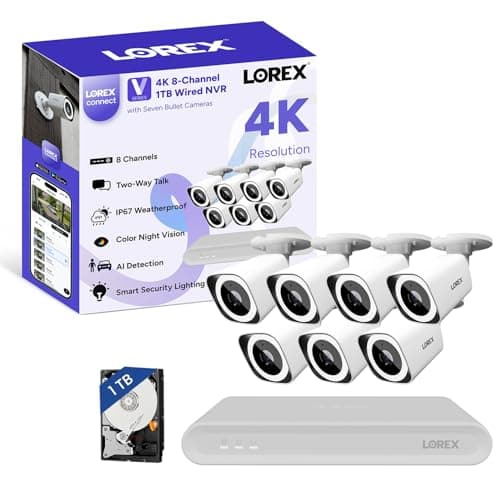
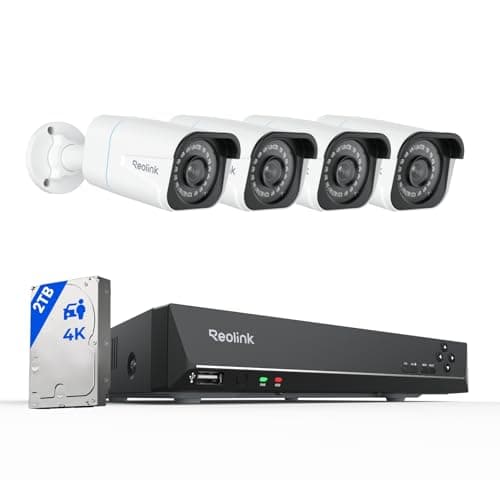
"Lorex vs Reolink" is the search people run when they have decided to stop renting their footage. Both of these are wired Power-over-Ethernet systems: each camera takes one Cat-5e cable that carries power and video together, the recorder sits in a cupboard with a hard drive in it, and the whole thing records continuously with nobody billing you monthly. If that is what you want, either system delivers it. The difference is what is in the box.
The shared ground: wired, 4K, fee-free, 24/7
Start with everything that is a tie, because it is why both systems are on this page. Both are eight-channel PoE systems. Both publish 4K/8MP cameras. Both include a hard drive and record around the clock to it, so you get a real timeline rather than the motion clips a cloud camera gates behind a plan. Both are IP-rated for outdoor mounting, and neither charges a subscription — Lorex states "No Monthly Fees" and Reolink records entirely to the drive in the box. Both also mean cable: a PoE system is the most reliable way to run cameras and the least convenient to install, which is the trade covered in wired vs wireless cameras.
Cameras per box versus terabytes per box
The Lorex kit arrives with seven cameras and 1TB. The Reolink arrives with four and 2TB. Everything else follows from that.
Seven cameras is whole-property coverage — front, back, both sides, drive, garden, shed — and it costs less per camera than the Reolink kit does. If you know you want that many views, the Lorex is the cheaper route to them, and buying four cameras now and three later costs more than buying seven today.
But 1TB across seven 4K streams is the pinch point. Continuous 4K recording is the most storage-hungry thing a home camera system does, and spreading 1TB across seven cameras gives you a notably shorter window before the oldest footage is overwritten than 2TB across four. That window is the whole value of an NVR: it is how far back you can go when you only find out on Thursday that something happened on Monday. Lorex supports up to 10TB, so this is fixable for the price of a surveillance-rated drive — just budget for it rather than discovering it.
Software: retrieval versus specification
Lorex is ahead on getting footage back out. Smart Search filters recordings by motion type and colour, and the monitor-less setup mode means you can commission the recorder from a phone instead of carrying a television to the loft. Both of those are the sort of feature you only appreciate after the install.
Reolink is ahead on knowing what you bought. Its listing states resolution, weather rating, compression and detection for the cameras themselves, which makes the kit easy to hold the brand to. Reolink's app is plainer, and H.265 being named matters more than it sounds — it is why continuous recording stretches as far as it does on a 2TB drive.
What neither of these does
Neither kit is a deterrence system. Lorex publishes no siren, two-way talk or active deterrence for this system, and the Reolink kit is a bullet-camera recording package too. If you want a light that comes on and a voice that says something, that is a floodlight camera beside the NVR — see best floodlight cameras. And neither is an alarm: cameras record what happened, an alarm interrupts it while it is happening, which is the distinction in do I need a security system or just cameras.
Neither system supports Matter, Apple Home or any shared camera standard either. Wired NVR systems live in their own app by design, and what is a PoE camera explains why that is the normal trade for this class of hardware.
How to decide in two questions
How many views does the property actually need? Walk it and count the approaches — every door, the drive, any side gate, and the dark corner nobody overlooks. If the number is four or five, buy the Reolink and keep the spare channels in hand. If it is six or seven, buy the Lorex, because seven cameras bought together is cheaper than four plus three.
How far back do you need to be able to look?This is the question people skip and then regret. Continuous 4K eats storage; the more cameras share a drive, the shorter the loop. If you want weeks rather than days, either buy the Reolink's 2TB or budget a bigger surveillance-rated drive for the Lorex on day one. Our guide to how long security cameras keep footage shows how the arithmetic works out.
Two practical notes for either system. First, run the cable properly: a PoE system is only as reliable as its weakest termination, and the cameras are mounted where you will not want to revisit them. Second, keep the recorder somewhere ventilated and not obvious — the NVR holds every recording, so a burglar who finds it takes the evidence with them.