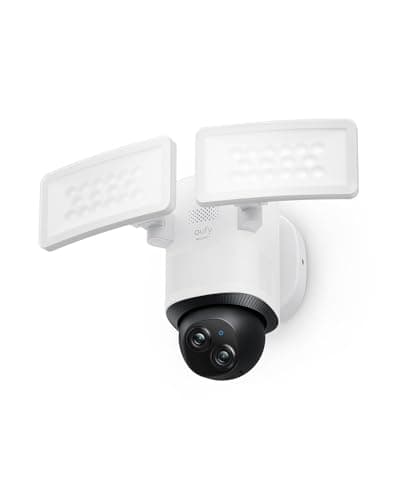
A floodlight camera is two products in one housing, and most reviews only grade one of them. The light is a deterrent: bright, wide, and the thing that actually changes behavior on a dark drive. The camera is a record: it has to resolve enough detail, at enough distance, to be worth looking at afterwards. The eufy Floodlight Cam E340 is unusual because it takes the second job seriously in a way almost nothing else in the category does — and because it does it without ever asking for a subscription.
What makes it different: the head turns
Every other mainstream floodlight camera is a fixed lens. You aim it once, at install, and whatever falls outside that cone is not covered — which is why the usual advice for a corner of a house is to buy two. The E340 mounts its camera assembly on a motor with a published 360 degrees of pan and tilt, and supports up to four preset positions you can snap to from the app. In practice that means one fixture on the corner of a garage can hold a preset on the driveway, a preset on the side gate and a preset on the back door, and eufy publishes motion-triggered tracking that follows people, vehicles and pets rather than simply noticing them leave frame.
The honest limit of that is the same limit every pan-and-tilt camera has: it is only pointing one way at a time. If the head has swung to the side gate, it is not watching the driveway, and no amount of tracking changes that. A moving camera trades guaranteed coverage of one frame for possible coverage of several. For a general-purpose look at a property that is a good trade. If you need one fixed, always-recording frame for insurance or evidence purposes, a motorized head is the wrong tool and a wired system is the right one — we lay out that distinction in best wired security camera systems.
Two lenses, and why that beats a bigger number
The E340 carries a 3K wide lens and a separate 2K telephoto, with up to 8x hybrid zoom between them. That is a more useful arrangement than a single higher-resolution sensor, and the reason is that resolution is not detail — it is detail per degree of view. A single wide lens spreads its pixels across the whole arc, so a face 40 feet away lands on a few dozen of them and digital zoom cannot invent more. A dedicated telephoto keeps a genuinely tighter frame running alongside the wide one, which is how you get a scene shot and an identification shot from the same fixture. We go through the arithmetic in 2K vs 4K security cameras.
The light is 2,000 lumens at 4,000 K, dimmable. That is the same published output as Ring's Floodlight Cam Wired Plus at a cooler color temperature, and the dimming matters more than the headline figure in a dense neighborhood — a floodlight that annoys the house opposite tends to get angled away until it covers nothing. Light is also the cheapest improvement available to any night-time image, which is the real reason a floodlight camera beats a plain camera on a dark wall. Our guide to security camera night vision explains why a lit color scene reads so much better than infrared gray.
The subscription math, which is the point
eufy states that recording and notifications work with no monthly subscription fee. Footage goes to a microSD card inside the camera, up to 128 GB, or to a eufy HomeBase S380 that accepts a drive up to 16 TB. There is no tier that unlocks person detection, no tier that unlocks saved clips, and nothing that stops working if you cancel something — because there is nothing to cancel.
Set against the obvious alternative, that is where most of the value sits. Ring's Floodlight Cam Wired Plus is frequently cheaper to buy and requires a Ring subscription to save and review recorded video, so the cost of the two fixtures crosses over inside the first couple of years and then keeps diverging for as long as you own them. That is the whole case for the E340 in one sentence, and we do the three-year arithmetic properly in security camera subscription costs. If no-fee recording is your priority across the whole house rather than just this fixture, best no-subscription security cameras is the page to read next.
The install is the real cost
This is where people underestimate the E340. eufy requires hardwiring to AC 100-240 V into a UL-listed junction box — there is no battery version and no plug-in option. If you are replacing an existing security light on the same wall, that is a straightforward swap and the wiring is already there. If you are putting a floodlight camera somewhere that has never had one, you are looking at running mains cable to an exterior box, which in most households means an electrician and is not a thing you redo because you picked the wrong corner.
Two consequences worth planning for. First, decide the mount point before you buy: a motorized head is heavier and bulkier than a fixed unit and you will not want to move it. Second, check your Wi-Fi at the wall. The E340's dual-band Wi-Fi 6 radio is the best-specified in its class and will happily use 5 GHz if it can reach it, but an exterior wall at the far corner of a house is often the weakest point in a network, and a 3K stream is not forgiving. Our placement guide covers heights and angles, and why is my security camera offline covers what to check before blaming the camera. One other thing worth knowing at install time: the camera's own motion sensing only reaches as far as its lens does, so if you want the light to come on before someone is already in frame, a separate outdoor motion sensor triggering it is the fix — we rank those in best motion sensors.
What eufy does not publish
Three gaps, and we would rather name them than fill them in. There is no published decibel figurefor the E340's alarm — Ring, Reolink, Wyze and Blink all publish 105 dB for theirs, and eufy does not publish one at all, so we cannot tell you how loud it is. There is no published operating temperature range, where Ring publishes -5 F to 118 F for its equivalent; the camera is IP65 against water and dust, but cold is a separate claim and it is not made. And there is no Matter certification and no HomeKit, which eufy states explicitly rather than leaving ambiguous. For a buyer in a cold climate the second gap is the one to weigh; we cover what those ratings mean, and what happens past them, in do security cameras work in cold weather.
Who should buy something else
Three households, clearly. If your smart home runs on Apple Home, this camera will never appear in it — eufy says so — and that is a dealbreaker rather than an inconvenience; the field is mapped in security camera ecosystem compatibility. If you want the cheapest way to put a camera inside a security light and you are already in Alexa, the Ring and Blink fixtures cost substantially less up front, with the subscription caveat above — and the head-to-head is in eufy Floodlight E340 vs Ring Floodlight Cam Wired Plus. And if your real problem is a long driveway rather than a wall corner, a floodlight camera at the house end is the wrong fixture for the far end of it, which we work through in best security cameras for driveways.
The verdict
The E340 is the floodlight camera we point most people at, and the reasons are structural rather than marginal: it covers more of a property than a fixed camera can, it resolves more detail at distance than a single wide lens can, and it never asks for money again. Weighed against that are a genuinely demanding install, a 128 GB card ceiling, a few specifications eufy declines to publish, and a flat refusal to work with Apple Home. If you are hardwiring to an existing light position and you live in Alexa, Google or eufy's own app, it is the easiest recommendation in the category. If you are an Apple household, buy something else — and we would rather say that in the review than in the returns policy. The full field, ranked, is in best floodlight cameras.